English
Gaeilge
Communities can lead the way in climate action as “Power to Change” unveils significant findings
A significant partnership between Atlantic Technological University (ATU) and the Sligo Public Participation Network (PPN) has demonstrated the potential of community-led climate action — and revealed the urgent need for greater support of Ireland’s community and voluntary sector at local and national level to assist the sector to fully engage with environmental action.
The Power to Change project, funded by the Government of Ireland through the Department of Climate, Energy and the Environment under the Community Climate Action Programme (Strand 2), ran from 2022–2025 and engaged directly with 14 community groups, 7 community space managers, and 11 schools. Its mission was to empower communities within the ATU region to take meaningful, practical climate action through tailored mentoring, training, and co-created learning resources.
The project grew from earlier collaborative work between ATU and Sligo PPN that included the co-creation of the Community Environmental Toolkit. The work highlighted a pressing need – in order to engage with positive climate action, community groups would need tailored training that was bespoke, locally relevant, and responsive to their own ambitions and existing group demands.
Power to Change delivered upon this need — three interconnected strands of activity that built capacity, shared knowledge, and strengthened links between community settings and education environments. A suite of toolkits and learning resources created during the project is now publicly available at https://www.sligoppn.com/power-to-change/ .
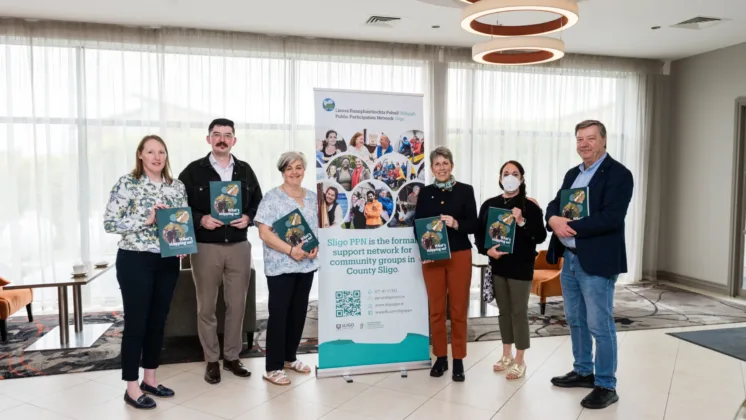
Recognising that the everyday realities of community work are prohibiting community groups from engaging with climate action and other key priorities, Power to Change commissioned a major national study led by Dr Harriet Emerson. The resulting report — “What’s stopping us? Barriers to action by Community and Voluntary Groups; with specific reference to involvement in Climate Action” was officially launched at the Sligo PPN Community Expo Day on 18 May 2026.
The Sligo PPN Community Expo Day, which took place in the Clayton Hotel, saw over 30 local community and voluntary organisations come together to showcase their work, network and explore opportunities for creating relationships across the PPN network. Given the wealth of sectoral representation in the room, the event provided the ideal platform to launch the research and engage attendees in initial discussions on the findings.
Research Exposes the Scale of Community Sector Challenges
This research placed community voices at its centre, using focus groups to co-design a national survey that received 355 responses, representing organisations with a combined reach of at least 35,000 people across every county in Ireland.
The findings are stark:
· Volunteer Recruitment — 80% of groups said this challenge is greater than manageable.
· Securing Core Funding — 74% reported this as greater than manageable.
· Obtaining Project Funding — 81% identified this as greater than manageable.
· Managing Administration — 65% said administrative demands exceed manageable levels.
· Accessing Suitable Accommodation — 47% struggle to find appropriate space to operate.
These results provide a clear evidence-based confirmation of what community groups have long known: the sector is carrying enormous responsibility with insufficient structural support.
A Call for National Recognition and Investment
Speaking at the launch, Dr Emerson emphasised that community groups are “ready and willing to lead climate action — but they cannot do it while battling systemic barriers that drain capacity and limit ambition.”
Sligo PPN echoed this message, noting that the challenges facing community organisations are deeply interconnected. Strengthening the sector is not only essential for climate action — it is vital for social inclusion, wellbeing, and local resilience.
At the launch event organisations identified that they feel they are constantly forced to jump through hoops to simply carry out activities that save the government money and make positive changes in local communities.
“Managing public and government expectations of our work [is a challenge]. The more we do, the more is expected and the less it’s appreciated.” (Residents’ group)
Communities Have the Power to Change — But They Need Support
The Power to Change project has shown what is possible when communities are given the tools, training, and confidence to act. Now, the call is for government, funders, and partners to match that energy with sustained and properly coordinated investment and policy support.
The report contains a list of recommendations, developed with the community sector, that would support groups to go from merely struggling to survive, to being able to take a
really proactive role in achieving key national targets around climate, inclusion and wellbeing. The next step is to work with local and national governments, and statutory organisations to put in place real, tangible, practical supports to help the sector thrive.
Commenting on the research findings and Power to Change project Dr John Bartlett, Head of Research, ATU Sligo said
The solution to climate change must and will come from the actions of individual citizens, focused through community groups, whose successes will then support and inform government policy and action. ATU has a particular focus, on and commitment to, supporting citizens and communities on this journey of education, energy saving and local energy generation. This project is an example of the very best of these initiatives. Congratulations to all.
For more information, resources, and project outputs, visit https://www.sligoppn.com/power-to-change/
Photo Caption: Dr Yvonne Lang (ATU), Ryan Dempsey, Dr Harriet Emerson, Dr Orla Flynn (ATU President), Sarah Wetherald (Sligo PPN), Dr John Bartlett (ATU).
For media enquiries, contact:
Aidan Haughey
Communications Manager
Tel: 086 086 6913
E: aidan.haughey@atu.ie