

Courses
Advanced Manufacturing
Postgraduate Diploma in Engineering
Course Details
| Course Code | LY_MAMAN_G |
|---|---|
| Level | 9 |
| Duration | 1 year |
| Credits | 60 |
| Method of Delivery | Blended |
| Campus Locations | Donegal – Letterkenny |
| Mode of Delivery | Part Time |

Course Overview
RQF Level: 7
North West Digital Employment Pathways Training Hub (NW DEPTH) – is supported by PEACEPLUS, a programme managed by the Special EU Programmes Body (SEUPB) – and is led by Atlantic Technological University in partnership with Ulster University, North West Regional College, and Donegal Education and Training Board via their well-established strategic collaboration, the North West Tertiary Education Cluster (NWTEC).
It is the aim of this programme to produce graduates who will be able to demonstrate mastery of the knowledge, skills and tools required for the development of advanced Industry 4.0-compliant manufacturing systems. They should be able to apply creativity in the design of systems, components and processes involved in product design for automation, cyber-physical systems, and IoT control of industry processes.
Graduates would expect to find employment in several types of organisations: within large companies in a structured role and in small development companies in a more flexible role.
The main aim of the programme is to give students training and qualifications for careers in advanced and modern manufacturing industries.
Course Details
Year 1
| Semester | Module Details | Credits | Mandatory / Elective |
|---|---|---|---|
| 1 |
Industrial Internet of Things (IIoT) & Cyber Physical Systems (CPS)This module provides an in-depth exploration of the Industrial Internet of Things (IIoT) and Cyber Physical Systems (sensors, control boards) to enable intelligent industrial systems. Students will work with real-world industrial sensors, IIoT gateways, and edge computing devices to collect, process, and analyse manufacturing data for predictive maintenance, quality control, and process optimisation using data analytics & machine learning. Learning Outcomes 1. Evaluate the role and impact of IIoT and CPS in modern manufacturing environments. |
10 | Mandatory |
| 1 |
Data Science & Machine LearningThis module provides a comprehensive introduction to machine learning (ML) with a strong emphasis on deep neural networks, tailored specifically for advanced manufacturing applications. Using PyTorch as the primary framework, students will learn to develop, train, and deploy ML models for real-world industrial challenges such as predictive maintenance, quality control, and process optimisation. The module covers: Core ML techniques (supervised/unsupervised learning) for manufacturing data. Deep learning fundamentals, including CNNs for visual inspection and RNNs for time-series forecasting. Cutting-edge architectures like Transformers (for sequence/vision tasks) and Generative AI (VAEs, GANs) for synthetic data generation. Deployment strategies (ONNX, edge AI) and ethical considerations (bias, explainability). Hands-on labs and a project will enable students to apply PyTorch-based solutions to manufacturing datasets (e.g., defect detection, tool wear prediction). By the end, students will be equipped to integrate ML into Industry 4.0 systems. Learning Outcomes 1. Analyse manufacturing datasets and select appropriate machine learning and deep learning techniques. |
10 | Mandatory |
| 1 |
Virtual Manufacturing & Digital TwinsThis module introduces students to virtual manufacturing and the creation of digital twins to simulate, optimise and enhance manufacturing processes. By leveraging advanced digital tools and techniques, students will gain hands-on experience in developing process designs, simulating process behaviour and optimising process workflow. Also, students will learn how to apply Lean principles to evaluate process performance, identify inefficiencies and propose process solutions for continuous improvement. Learning Outcomes 1. Use CAD tools to model realistic products for integration with the digital simulations. |
10 | Mandatory |
| 2 |
Digital Inspection & Quality AssuranceThis module provides an in-depth understanding of quality control and digital inspection techniques in modern manufacturing. It concentrates on 3D scanning, reverse engineering, geometric dimensions and tolerances (GD&T) and machine vision to ensure product accuracy and quality compliance. Students will develop hands-on expertise in digital inspection methods using advanced scanning technologies, coordinate measurement machines (CMMs) and automated vision systems for defect detection and quality assurance. Students will adopt statistical process control (SPC) tools such as control charts and process behaviour analysis to effectively monitor and control manufacturing processes. Learning Outcomes 1. Utilise 3D scanning technology (7-axis Hexagon scan arm) for reverse engineering, precise digital inspection & quality assessment. |
10 | Mandatory |
| 2 |
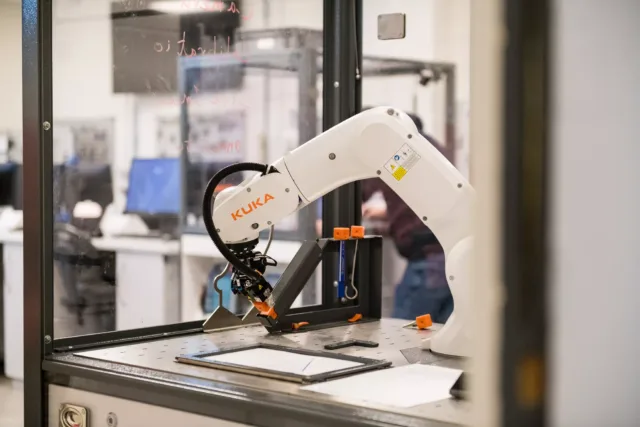
Manufacturing AutomationThis module equips students with advanced knowledge and hands-on experience in programming and integrating industrial robotic systems within modern manufacturing environments. It covers advanced PLC programming, electro-pneumatics, and Human Machine Interface integration, enabling the development of fully automated systems. A strong emphasis is placed on sensor integration and machine vision systems to enhance automation and system intelligence. Learning Outcomes 1. Program and optimise robotic cells for common manufacturing tasks. |
10 | Mandatory |
| 2 |
Sustainable Manufacturing SystemsThis module explores sustainability in advanced manufacturing, integrating environmental, social, and economic considerations into manufacturing processes. It explores the principles, strategies, and tools to develop more sustainable products and systems. The module will equip students with the knowledge and skills required to implement sustainability concepts within manufacturing environments, focusing on practical applications of circular economy principles to reduce waste, extend product lifecycles, and optimise resource efficiency. Learning Outcomes 1. Redesign manufacturing processes using circular economy principles, considering material efficiency, product lifecycle extension, and waste minimisation. |
10 | Mandatory |
Recommended Study Hours per week
There will be 4 hours of lecturing each week for each module. There are three modules per semester and there are two semesters. Two hours of theory will be taught online in the evenings for each module and the two hours of practical will be taught on campus for each module (within one day). There is also a recommended 11 hours per week of independent learning for each module.
Examination and Assessment
All assessment in this course is continuous assessment with no final exams. A range of assessment methods may be used, including:
– Individual Assignments
– Group Assignments
– Online class/lab tests
– Presentations/demonstrations
– Individual Assignments
– Group Assignments
– Online class/lab tests
– Presentations/demonstrations
On-Campus Attendance Requirement
This course will be taught in blended mode. The theory for each module will be taught online in the evenings and the practical aspects will be taught on campus. It is expected that students will be on campus for 1 day per week.
Progression
Graduates of this course can go on to complete the MEng in Advanced Manufacturing.
Download a prospectus
Entry Requirements
Entry to this programme will be available to applicants who meet one of the following criteria:
An Honours Degree in Mechanical or Electronics Engineering or an equivalent qualification.
Candidates who do not have an Honours degree but have significant relevant experience may also be eligible for consideration via Recognition of Prior Learning (RPL).
Fees
This programme is offered free to eligible candidates via NW Depth. Within the application process, select ‘Other’ in response to the question "How is this course being funded?". When prompted to provide the funder organisation, enter ‘NW DEPTH’.
Further information on feesCareers
Graduates from this programme will be able to seek employment as graduate engineers and engineering technicians. Salaries for graduate engineers vary widely, entering the scale at about €40,000, and continue through to senior engineering and engineering management roles.
Further Information
Application Closing Date
This course has now closed for applications for September 2026.
Start Date
14th September 2026
Who Should Apply?
This programme is suitable for recent engineering graduates who wish to extend their education and enhance their employability by gaining advanced knowledge in smart manufacturing, automation, and data-driven decision-making.
It is also ideal for early to mid-career professionals (including production technicians, quality assistants, and maintenance staff) who are looking to transition into engineering or supervisory roles. The programme supports those seeking to future-proof their careers and take advantage of emerging opportunities in advanced and digital manufacturing environments.
Contact Information
For queries in relation to North West Depth, please contact:
E: info@mynwtec.com
Department of Electronic and Mechanical Engineering
Dr Emmett Kerr
Head of Department
T: +353 (0)74 918 6401
E: emmett.kerr@atu.ie