

Courses
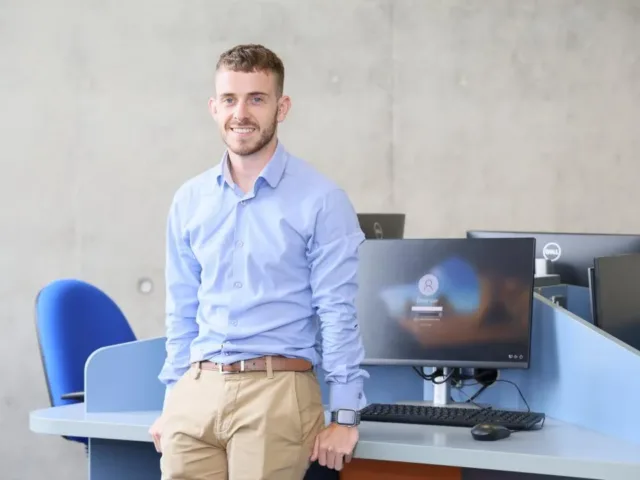
Gary Leavy
Bachelor of Science (Hons) in Architectural Technology
Galway City – Dublin Road
Tell us a little bit about yourself and what led you to choosing your course?
I chose the Architectural Technology degree at ATU due to its hands-on approach and inclusion of continuous assessment. Throughout the four-year degree, my understanding of construction and the industry steadily grew, with each year bringing new knowledge and insights.
I currently work as a BIM Engineer with John Sisk & Sons in Galway.
A highlight of my time at ATU
Being asked to represent the university at the BIM WorldSkills Nationals was one of the highlights of my time at ATU. I had the chance to network with many talented people in the field, which was a great experience for me. Although I was disappointed not to qualify for the national team, I still have great memories of it.
Achievements
I received a BIM Visualisation certificate in the third year of Architectural Technology. This competition involved submitting internal and external renders of a detailed design project. Upon receiving this certificate, I gratefully accepted the Samsung Gear S3 Classic smartwatch sponsored by Autodesk.
In my fourth year, my classmates selected me as the student representative, entrusting me with the responsibility of conveying ideas and feedback within the group and fostering better interaction between students and lecturers.
What is unique about studying at ATU?
The atmosphere at university is distinctive, and I believe having approachable, supportive lecturers and friendly staff makes it easier to attend classes. Everyone, from the canteen staff to the lecturers, is very welcoming and supportive. Lecturers who genuinely care can make university life a much more positive experience.
What are the key skills you learned while at ATU that have influenced your career?
The Architectural Technology programme is very hands-on and includes many continuous assessments. Your understanding of construction and the industry grows immensely over the four years, with each year bringing additional knowledge and insight. The five construction principles we learned made it easier to deconstruct even the most complicated designs (Structure, Insulation, Waterproofing, Airtightness, and Finish).
Group projects are frequent, particularly in the final two years of the course. This helps students learn how to collaborate effectively, which is crucial in the workplace. It also develops communication skills and leadership abilities, especially when leading projects.
Modules such as Detail Design and Architectural Technology provided a thorough understanding of how structures are assembled and function. My career in the construction sector has greatly benefited from these skills and the knowledge I gained in these modules.
I found the BIM-related modules particularly interesting, and from first year, I knew this was where my interests lay. Throughout the four years, the two BIM lecturers in my lecture group provided a wealth of information and guidance. Their support unquestionably had a positive impact on my career, as well as on the careers of many others.
What advice would you give to someone thinking of doing your degree at ATU?
In my opinion, Architectural Technology is a fantastic course to enrol in. All of the lecturers are helpful, and you genuinely get the sense that they want you to succeed if you are willing to put in the effort.
Smaller lecture groups and one-on-one interaction with lecturers are essential for growth and development, and I believe this is something the ATU course does very well. The course’s diverse modules also provide a wide variety of career opportunities.
Although I chose to pursue BIM, which is essentially the digital side of construction, there are many other career paths available through the technical side of the course. Examples include careers in conservation, construction technology, and environmental aspects of the building industry.
I would say to anyone considering the course that you get out of it what you put into it. If you attend lectures consistently, your lecturers will support you whenever you need help understanding or completing an assignment. The three to four years pass quickly, so try to stay motivated and never hesitate to ask questions.
Career Path
I gained experience working in an architectural firm in Tullamore, my hometown, during the summer after my third year. I worked there for almost five months as a BIM Technician and Architectural Technologist. It was a fantastic place to work, and I gained invaluable experience that helped me complete my final year at university. However, I knew I wanted to broaden my understanding of the construction sector.
As my fourth year was coming to a close, I applied for the graduate BIM Engineer programme with John Sisk & Sons. Initially, I had little understanding of what a BIM Engineer’s career would involve, but I applied because I had heard excellent things about Sisk. Thankfully, after a nerve-wracking interview, I got the job.
I currently work with Sisk’s Digital Project Delivery (DPD) team, which is revolutionising digital building techniques and constantly exploring emerging technologies. I am now in the eighth month of the twenty-seven-month graduate programme and am continuing to learn and develop professionally.
Joining a graduate programme straight out of university is a great option because it helps ease the transition from education into the professional world, allowing you to gradually find your feet. This division of the business is continuously expanding and shows no signs of slowing down.
I am really enjoying the work involved in this sector, as it is new to me and I always welcome a challenge. Due to the number of active projects in mainland Europe, there are also travel opportunities within the role. At present, I am travelling back and forth to Belgium to support the Senior BIM Engineer on a live project, with expenses covered. This incredible opportunity has opened my eyes to what it is like to live and work abroad.
Eventually, I hope to have the opportunity to work in the data industry, as these projects can be extremely large in both budget and scope.