English
Gaeilge
Yes, jaguars meow- and an ATU researcher helped prove it
An Atlantic Technological University (ATU) researcher has played a key role in a global scientific first: documenting meow-like vocalisations in wild female jaguars in Brazil’s Iguaçu National Park.
The discovery, published in a peer-reviewed scientific study, challenges long-held assumptions about big cat communication and reveals a previously undocumented complexity in jaguar vocal behaviour.
For the first time ever, researchers recorded meow-like calls produced by female jaguars in the wild- vocalisations that had never been documented for this species or sex. The recordings were captured during long-term camera trap monitoring in Iguaçu National Park, one of the world’s most important jaguar conservation areas, set up by a team of scientists from several academic institutions, including the University of Salford, Iguaçu National Park, Atlantic Technological University, and WWF.
The study identified three separate vocalisation events involving two different females: two recordings from an adult female searching for her cubs, and one from a young dispersing female believed to be calling for her mother.
Analysis suggests the meow-like calls occurred during temporary separation between mothers and cubs, pointing to a communication similar to domestic cats seeking contact with their young. This behaviour offers a rare glimpse into maternal communication in jaguars.
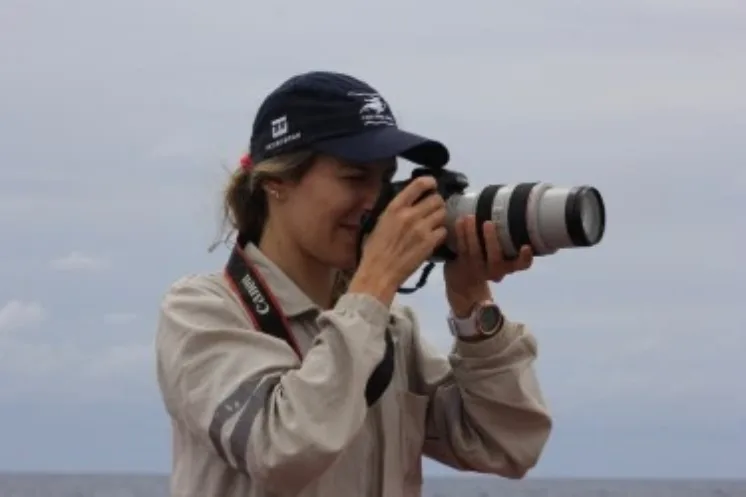
Yasmin Viana, a bioacoustics researcher based at ATU’s Marine and Freshwater Research Centre, is a co-author of the study and played a central role in uncovering this scientific first.
She extracted audio from long-term camera trap footage and carried out detailed acoustic analyses, including measuring frequency ranges, durations, and dominant energy bands, and producing the spectrograms used in the scientific paper. Her work was critical in identifying and describing the meow-like characteristics of the calls and comparing them with known jaguar vocalisations.
“It was a bit challenging, as we had to discard some recordings where the vocalisations were overlapped by natural low- to mid-frequency background noise such as rain and other animal species,” she said. “However, one advantage of working with camera trap videos is that we could directly confirm the jaguar’s presence and behaviour while the sound was being produced.”
She added that the discovery highlights the power of bioacoustics as a research tool.
Acoustic monitoring lets us study animals even when we can’t see them- at night, in inaccessible habitats, or in challenging weather- from the depths of the ocean to the heart of a rainforest.
The findings also contradict long-standing assumptions that adult members of the Panthera genus- which includes lions, tigers, and leopards lack the anatomical flexibility to produce high-pitched, meow-like sounds.
The real “wow” moment came during the analysis, Yasmin explained.
“Although all the calls sounded meow-like- sharp, brief, and high-pitched- they weren’t identical. Each recording had its own distinct acoustic structure, almost like different types of meows.”
The discovery suggests that the jaguar vocal repertoire is far richer and more context-dependent than previously documented. It also highlights the growing importance of bioacoustics in wildlife research. By combining acoustic data with visual confirmation from camera traps, researchers are uncovering behaviours that had gone unnoticed despite decades of jaguar study.
Yasmin Viana is currently a Postdoctoral Researcher at ATU working on the EU Horizon-funded Marine Beaco\ZAAAA\n Project, which examines the impact of underwater noise on protected marine species and the wider marine soundscape.
Photo caption: Yasmin Viana, a bioacoustics researcher based at ATU’s Marine and Freshwater Research Centre
This piece is part of Bright Minds, Big Impact, a series highlighting ATU’s research excellence and the people driving meaningful change.
For media enquiries, contact:
Ivana Hanjs
Communications Officer
Tel: 089 963 9559
E: ivana.hanjs@atu.ie