English
Gaeilge
Opinion piece: Are we ready for AI-powered smart glasses on our children’s faces?
Atlantic Technological University (ATU) instructional designer and researcher in Artificial Intelligence (AI) Frances O’Donnell has warned that next-generation AI smart glasses, rolling out globally in 2026, could fundamentally reshape how young people interact with technology, raising urgent questions around privacy, safety, ethics and children’s digital rights.
Her warning comes as Snapchat announced the launch of Specs, its latest consumer augmented reality (AR) glasses. They look like regular sunglasses but have built-in cameras and are designed to layer digital objects onto the physical world, recognise locations, identify objects and faces, and run machine-learning models in real time- all from a device worn on the face.
Snap Inc. has invested more than $3 billion in this technology over the past decade. With Snapchat expected to reach nearly one billion monthly users by 2026, experts say that face-worn AI will trigger a major shift in how society, and particularly children, navigate daily life.
Frances O’Donnell says this moment is far beyond experimentation and reflects a major turning point:
This has moved far beyond the experimental stage. We’re looking at a fundamental shift in how we live with AR and generative AI in our day-to-day lives. Smart glasses aren’t new; companies have invested millions to bring them to a point where they offer real, hands-free convenience for work, learning and daily life. Western society thrives on convenience, and smart tech is a status symbol. Smart glasses will become increasingly visible in everyday settings.
Are parents ready for the shift?
A mother of three children who is currently completing a doctorate in AI in higher education says the speed of the shift is catching many parents and educators off guard.
“We are entering a moment where every day eyewear will also be an AI assistant, a camera, a navigation tool and an identity-shaping device. For many parents, the idea that a pair of glasses could track a child’s location, gaze and learning in real time feels like science fiction, but it’s arriving within months. The most pressing question is not whether the technology works. It does. The real question is whether society is ready for children to wear a spatial computer on their face.”
What are the risks for children?
Although Snapchat’s age restriction is officially 13, research shows children begin using the platform much younger. O’Donnell warns this is where the risks become acute:
“This is a huge question, and we urgently need robust research. The true implications will only become clear once use becomes widespread, just as we’re now recognising the long-term effects of social media on an entire generation.”
She says smart glasses affect children’s physical, cognitive, and social development.
“For children, this means their attention in the real world in play, conversation and learning could be interrupted or reshaped. There are also profound risks around data privacy, over-reliance on AI, bias, and children encountering strangers with little or no adult oversight. These concerns are only the tip of the iceberg.”
Potential vs risk
Meta, in collaboration with Ray-Ban and Oakley, is a leading brand in AI smart glasses, alongside Google, Apple and Samsung.
Meta’s latest Ray-Ban Display glasses include full colour AI-driven overlays, real-time information processing, and an optional Neural Band for motion control. A recent viral video showed deaf creator Chrissy Marshall experiencing real-time captions through AI-powered Hearview glasses, allowing her to “see” conversations around her.
O’Donnell says this illustrates the duality of the technology:
“Smart glasses can transform accessibility, learning, navigation and healthcare. But the same tools that empower can also expose. We have to design and regulate with both sides in mind.”
She sees genuine opportunities, but not without safeguards:
“There are promising opportunities for AR and AI smart glasses in education- from real-time support to enhanced accessibility for learners with hearing, visual, language or specific learning needs. However, the unknowns remain too great. Right now, the lack of policy, ethical safeguards and practical guidelines means the risks outweigh their immediate use in schools.”
Regulation and ethics
Frances O’Donnell stresses that these devices introduce a new scale of data capture:
“Imagine a child wearing smart glasses to school recording their walk, capturing parents with their children, filming teachers, classmates at lunch, or even inside bathrooms, all with no awareness or permission. A young user could unknowingly hold vast amounts of highly sensitive data: faces, voices, locations, biometrics. What happens to that footage? Where is it stored? Who can access it? At minimum, we need clear legal limits on what can be captured without consent and on how widely that data can be shared. Even existing online risks become amplified- a stranger a child meets online could potentially access their location or see what they’re seeing.”
Is society prepared?
ATU’s instructional designer says bluntly that we are not:
“In short, no. Society is already struggling to understand the impact of generative AI, and wearable AI moves these challenges into an even more intimate, always-on environment. These systems evolve so fast that it feels impossible to develop policy, guidelines or even basic awareness of their capabilities.”
She also highlights a growing inequality risk:
“My greatest concern is equity. Smart glasses may make it easier to complete tasks, learn or socialise, meaning those who can’t access them risk being left behind. This creates pressure to adopt the technology just to ‘keep up’, even while we still have no answers to the ethical, developmental and privacy issues. As a parent with children in primary school, the impact of generative and wearable AI is both personal and professional. We’ve seen what social media did and we cannot afford to be reactive again.”
Following recent legislative developments in Australia (10 December 2025), European lawmakers, specifically Members of the European Parliament (MEPs) passed a non-binding resolution calling for an EU-wide minimum digital age of 16 for social media, allowing access for 13 to 16-year-olds only with parental consent.
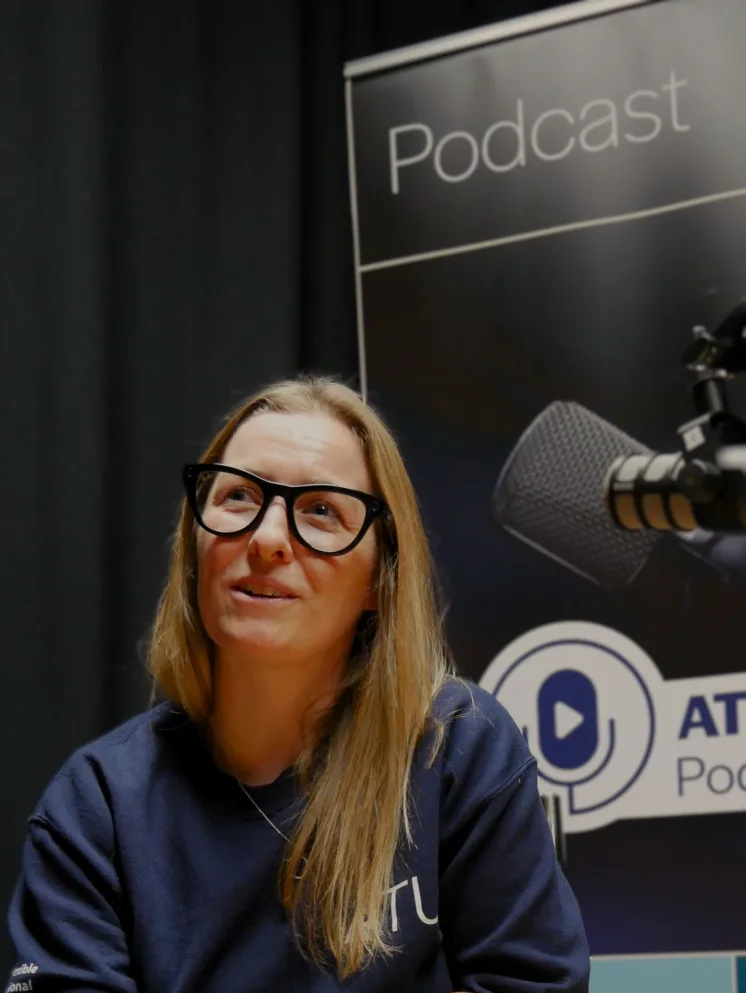
Photo caption: Frances O’Donnell, instructional designer and AI researcher at Atlantic Technological University
Explore how AI is transforming education in How artificial intelligence is reshaping education by Dr Susan Galavan, architect and lecturer at Atlantic Technological University.
This piece is part of Bright Minds, Big Impact, a series highlighting ATU’s research excellence and the people driving meaningful change.
Ivana Hanjs
Communications Officer
Mob: 089 963 9559
Email: ivana.hanjs@atu.ie