English
Gaeilge
Making medical images easier to share
PhD researcher Talha Meraj worked on a software solution to make digital pathology images easier to store and share.
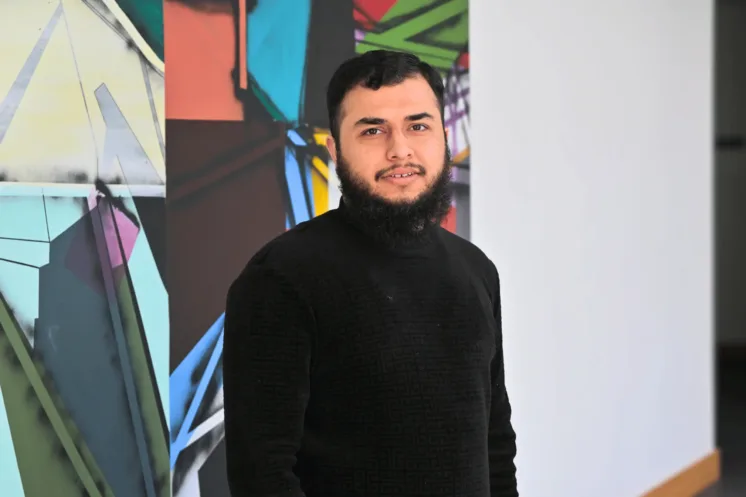
Funded by RISE@ATU, PhD researcher Talha Meraj undertook an industry placement with Cirdan, a Lisburn-based company specialising in digital pathology and laboratory information systems (LIS).
For Talha, the experience provided an opportunity to apply his knowledge in computer science and medical imagery into developing an open-source software prototype to address some of the current data compression and storage challenges.
“The aim of my project was to bridge this gap by developing a software prototype that converts Philips iSyntax whole-slide images into the internationally recognised DICOM standard”, Talha explained.
Digital pathology scanners produce extremely large, high-resolution images, which are often stored in proprietary formats. This can make it difficult to share images across different healthcare systems and research platforms.
“As Cirdan specialises in digital pathology and laboratory information systems, Talha focused on how these images could be stored and exchanged between them“, shared Tom Toner, AI Team Lead at Cirdan Ltd.
“Talha was embedded in the AI team throughout the placement, bringing a fresh perspective to this challenge and making a real contribution to our vendor-neutral digital pathology work”.
The placement was also a valuable two-way exchange, giving our team the opportunity to learn about Talha’s exciting PhD research into generative AI for virtual contrast enhancement in MRI – Tom Toner, AI Team Lead at Cirdan Ltd.
“Experiences like this demonstrate the value of industry placements in connecting academic research with real-world challenges, encouraging knowledge sharing and driving innovation”, he added.
During his placement, Talha worked on data interoperability in digital pathology, specifically, how large pathology images and their associated information can be stored and exchanged between different systems without losing original information.
DICOM, or Digital Imaging and Communications in Medicine, is an international standard for storing and exchanging medical images and related information. The prototype converts Philips iSyntax whole-slide images into DICOM, allowing the images to be stored and exchanged in a standardised format.
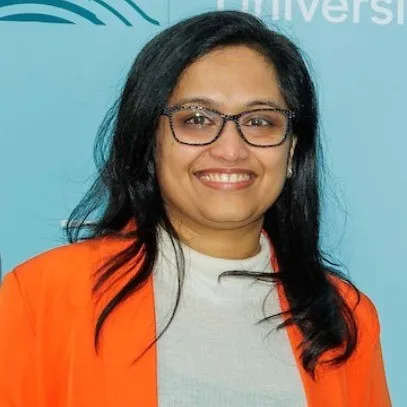
The enterprise placement served as a critical bridge for transferring academic knowledge into regional business while it shaped the PhD student’s understanding of real-world industry challenges”
– Dr Saritha Unnikrishnan, Lead academic supervisor
Working with the data behind the image
Digital pathology images can contain annotations identifying particular areas or features within an image. Talha’s software supports the conversion of GeoJSON annotations into DICOM annotation objects, preserving valuable clinical and research information alongside the images.
He designed the software using a modular structure, with separate components for image reading, metadata extraction, DICOM generation, annotation conversion, image compression and runtime validation.
This approach allows individual parts of the software to be developed and maintained separately.
Testing different approaches to image compression
Another part of the placement involved testing image compression methods.
As digital pathology images can be extremely large, the amount of storage they require is an important consideration. Talha developed a benchmarking module to compare different compression methods based on image quality, conversion speed and storage requirements.
Alongside the software itself, he produced technical documentation, a tutorial notebook and automated tests to support future development and use of the prototype.
Learning through industry
The placement gave Talha the opportunity to work on a project outside the university environment and to apply his experience in AI and medical image computing to an industry-based problem.
“This placement allowed me to apply my research in AI and medical image computing to a real-world industrial challenge while gaining valuable experience in collaborative software development.,” said Talha.
The work contributes to improving interoperability in digital pathology and provides a foundation for further development in areas including research, clinical workflows and AI-based medical imaging.
Dr Saritha Unnikrishnan is the lead academic supervisor who runs an computing research group research group at Atlantic Technological University (ATU), with Dr Michael McCann from ATU and Dr Ian Overton from Queen’s University Belfast as co-supervisors.
ATU, Queen’s University Belfast and Cirdan teams are currently working towards publishing the research findings in an international peer-reviewed journal.
About RISE@ATU
Talha’s placement forms part of MedAgriTech AI eXcellence (MATX), a four-year PhD research project funded by RISE@ATU in partnership with the Johnston Cancer Research Centre at Queen’s University Belfast. A 12-week industry placement is a mandatory requirement of this funding to enable regional enterprise engagement and innovation with researchers.
The PhD project aims to reduce the need for contrast agent injections in brain MRI examinations by replacing invasive contrast-enhanced imaging with virtual contrast enhancement using generative AI. This approach has the potential to reduce patient risk, lower healthcare costs, and improve access to safer, non-invasive imaging.
About Cirdan
Cirdan is a global medical imaging and pathology informatics company, founded in Northern Ireland in 2010 and headquartered in Lisburn. Cirdan develops innovative diagnostic technology to improve pathology workflows and support better patient outcomes. The company’s portfolio includes Laboratory Information Systems (LIS), digital pathology, specimen imaging, AI and interoperability solutions.
Working with over 200 clinical pathology laboratories worldwide, our solutions support healthcare professionals across more than 20 countries. Their mission is to improve wellbeing through innovation, delivering connected technology that helps laboratories work smarter and more efficiently.
For queries, please contact: saritha.unnikrishnan@atu.ie
Featured image: Talha Meraj, PhD researcher at Altantic Technological University.
RISE@ATU is co-funded by the Government of Ireland and the European Union through the ERDF Northern and Western Regional Programme 2021-27.