English
Gaeilge
Can AI help diagnose laryngeal cancer sooner?
Dr Jamie Roche, lecturer in Robotics and Automation at ATU, explains how his research has the potential to diagnose tumours much earlier than currently possible.

Laryngeal cancer is challenging to diagnose early and current referral pathways place heavy pressure on specialist clinics.
Dr Jamie Roche’s research, called the VOLITION (inVestigation of respOnsibLe human-aI collaboraTIOn for laryngeal cancer triaging) project, aims to change this. His work is developing an AI‑guided imaging system that learns from expert surgeons to support safe, accurate assessments in primary care.
What is the aim of the VOLITION project?
VOLITION is developing a new AI-powered imaging system that learns from the techniques of experienced head and neck cancer surgeons. By analysing data in real time, the system aims to help less experienced medical professionals, such as trainee surgeons, GPs, and speech therapists, better assess patients for laryngeal cancer.
The AI works by observing how experts examine patients (using a tool called flexible nasal endoscope) to identify suspicious lesions in the throat. This “human-in-the-loop” approach means the AI is continuously guided and validated by specialist knowledge. Ultimately, the goal is to provide consultant-level guidance in community settings, helping to ensure patients are properly assessed and safely referred when needed.
Head and neck cancers, including laryngeal cancer, are the sixth most common cancer worldwide. Yet in Ireland, they are not covered by the Rapid Access Clinic (RAC) system, the equivalent of the UK’s two-week wait referral pathway.
Dr Jamie Roche
What sparked your research in this area?
During my discussions with an ENT consultant at Cambridge University Hospital about the two-week wait referral pathway for Flexible Nasal Endoscopy (FNE) exams, she told me that her clinic sees 200 patients per session, with only 1-2% malignancy.
The £3.5m annual cost and large team (consultants, SHO, intern, student, nurses) raise value concerns, given laryngeal cancer affects 0.5% of the population and requires early diagnosis. This prompted my research into shifting initial screening to primary care to reduce costs, preserve specialist capacity, and improve patient flow.
We want to create a training tool that helps general healthcare workers, who aren’t throat specialists, to safely check patients with laryngeal lesions. The system will learn from the way expert doctors make their decisions by using artificial intelligence.
It will look at three things during an exam: the video from the camera in the throat, how the doctor moves the scope, and the patient’s voice.
By analysing this information, the system could help a nurse or general practitioner in a local clinic get a more accurate read on the problem, potentially without needing a specialist right away.
Explain what real time endoscopic imaging is and how it works?
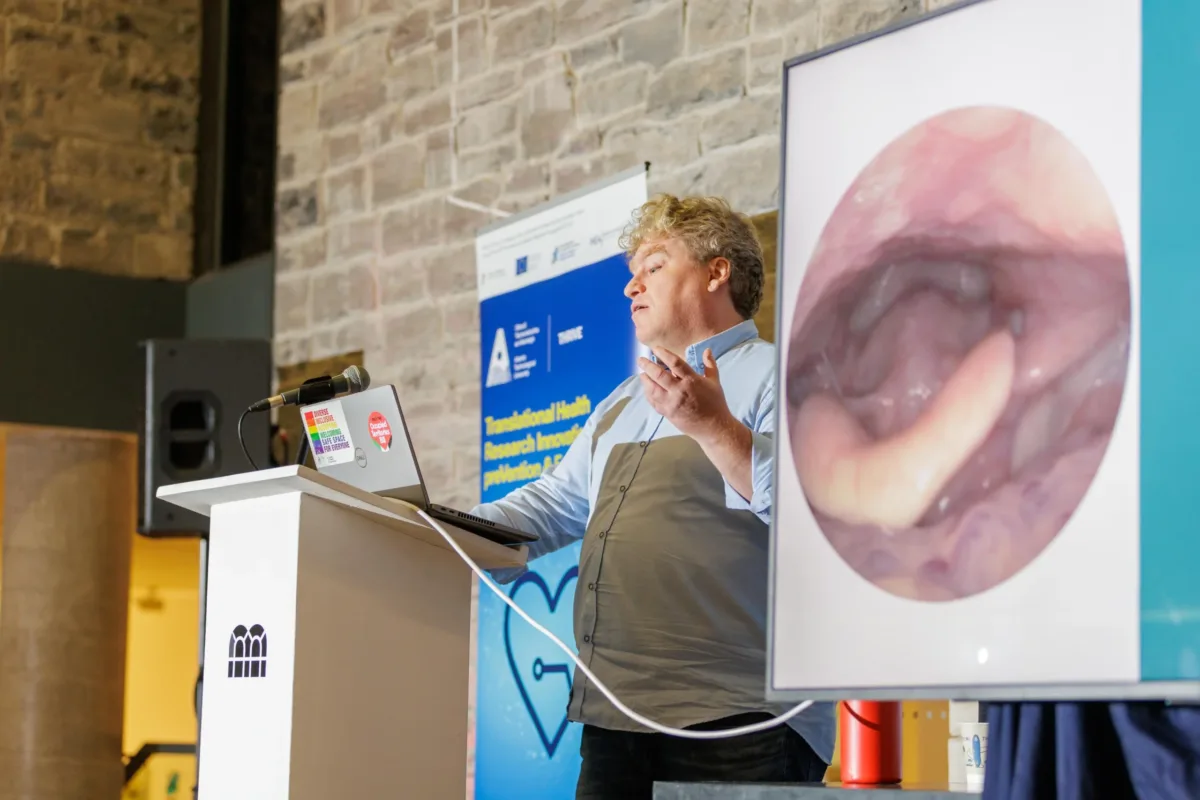
FNE imaging lets you see inside the body during a medical procedure through a live video feed from a thin tube called an endoscope. You insert the scope through the nasal passage, and a camera and a light at the tip illuminate tissue and convert reflected light into electrical signals that the consultant views on a screen.
You can adjust focus, zoom, and brightness while you watch tissue move and instruments interact with it in real time. This live view lets you detect abnormalities without invasive surgery.
No simple screening tool for throat cancer exists in communities, forcing patients with symptoms to see specialists at a limited number of centres, which causes long delays.
What role can AI play in assisting primary care clinicians during an examination?
VOLITION uses AI to train family doctors and speech therapists in laryngeal assessments. By learning from experts, the AI offers feedback for safe patient triage in primary care, easing specialist workload. This responsible AI includes tools for better imaging, tumour detection, and ongoing expert learning, aiming to speed up diagnosis and improve healthcare.
Could this technology help identify tumours earlier than is currently possible?
Yes, absolutely.
Ireland’s National Cancer Strategy aims to see 50% of non-RAC patients within 10 weeks and 90% within a year. In reality, only about 35% are seen on time.
Early diagnosis of laryngeal cancer is vital because some cancers can progress quickly without symptoms. However, the system is clogged.
Only about 1.5% of referrals actually result in a cancer diagnosis. A 2022 study found over 50% of head and neck referrals were low-risk, suggesting many could be safely managed outside hospital clinics.
The real solution is better screening in primary care. Equipping GPs to assess throat symptoms confidently would reduce unnecessary referrals and ensure specialists see the patients who truly need them.
What patient groups stand to benefit the most?
We are dedicated to creating fair, effective, and responsible AI for healthcare. Saying that, laryngeal cancer typically affects a certain cohort of the population.
Long-term tobacco use is the single greatest risk factor, implicated in over 95% of cases.
For these individuals, early detection through improved screening could identify precancerous changes or small tumors at a stage where minimally invasive treatment offers cure rates as high as 85-95%. This benefit is also critical for heavy alcohol consumers, particularly those who both smoke and drink, as this combination multiplies the risk of developing the disease.
What could this technology look like in five years?
It’s hard to say precisely but I think that in five years, the VOLITION technology could realistically evolve from a research prototype into a validated, clinical support platform. It would likely be deployed across a network of partnered primary care centres and ENT departments in Ireland and the UK, functioning as an integrated hardware and software system. A non-expert user, such as a GP or a nurse specialist, would perform a FNE exam.
Could it extend to other cancers or anatomical areas?
Yes, VOLITION was designed with a framework that could be extended to other cancers and anatomical areas. The proposal positions this extensibility as a key benefit beyond laryngeal cancer, where endoscopy is used in oncology assessments. The core innovation is not the specific application to the larynx, but rather a generalisable methodology for capturing, modelling, and disseminating expert clinical skills.
What would success look like for you at the end of the project?
Success for me would be measured across three key dimensions:
- A validated, trusted clinical tool
- Evidence of real-world impact on the RAC pathway
- Tangible influence on policy and practice
For media enquiries, contact:
Jorden McMenamin
Communications Officer
Tel: 074 918 6127
E: jorden.mcmenamin@atu.ie