English
Gaeilge
ATU Future of Work seminar hears how to prepare for challenges affecting labour markets
Over 80 Human Resource Management representatives from public and private organisations across the west attended a “Future of Work” seminar in Atlantic Technological University (ATU) Mayo this month (6 March 2026), organised by the board and staff of ATU’s Bachelor of Arts (Honours) in Human Resource Management programme.
Keynote speaker Dr Michelle O’Sullivan, Associate Professor, Dept of Work and Employment Studies at University of Limerick, outlined the three major challenges affecting labour markets: demographic change, artificial intelligence (AI), and climate change.
Dr O’Sullivan said Ireland’s old age dependency ratio is predicted to rise from 23% today to 50% by 2065, even on the unlikely assumption of high migration and high fertility. She emphasised the need for employers to respond through investment in upskilling their existing talent, providing clear progression pathways, and higher wages. Talent retention will increasingly depend on employers meeting workers’ expectations around matters such as working conditions and flexibility. She noted that most foreign holders of Critical Skills Employment Permits leave Ireland within five years and that this was another issue that needed to be addressed.
She added that there are mixed views on AI’s impact on the future of work, noting that attitudes towards AI depend on whether it is perceived as helping workers in their job or replacing them. The consensus view is that AI is more likely to be helpful to those in managerial roles, while those in administrative roles are in greater danger of being replaced. Current evidence suggests AI would lead to an increase in demand for analytical thinking skills, technology literacy, and cybersecurity. ‘Soft’ skills such as flexibility, agility, listening, and empathy would remain important. There would be continuing healthy demand for HR professionals with those skills.
Dr O’Sullivan observed that “Employers feel overwhelmed by AI’s rapid evolution, with many hesitant to commit investment funds to a technology that may quickly become obsolete.” She also noted a gender divide in the use of AI, with women using AI significantly less than men, a difference that becomes particularly pronounced at more advanced employment levels, which the ESRI describes as a ‘digital glass ceiling’.
She noted that change would likely result in a net increase in jobs, including new jobs in engineering, retrofitting, and other ‘green’ sectors. However, job losses are expected in traditional ‘brown’ sectors, such as fossil fuels, and it remains unclear whether the emerging ‘green’ jobs will offer comparable pay and conditions to those being displaced.
Keynote speaker Michelle Murphy, Director, Collins McNicholas Recruitment and HR Services Group, outlined the findings of a recent Workforce Insights Report, published by the recruitment company, in which the overwhelming sentiment expressed by the 2,500 professionals surveyed (for the report) was for recruiters to ‘keep a human touch’ in an era of AI.
Many respondents identified a lack of communication from employers and agencies, receiving impersonal automated responses, lengthy hiring timelines, and multiple interviews as among the main issues that would discourage them from working for an organisation. Many feared that AI would unfairly screen out their applications, saying they would be hesitant to apply for a job if they thought AI would be involved in the selection process. In this regard, Michelle Murphy highlighted the “Importance of recruiters having a policy on the ethical use of AI and on proper training for employees who screen candidates.”
Ms Murphy also advises that recruiters should remember that in an era of low unemployment, non-monetary benefits, such as clear progression opportunities, remote work/work from home options, company culture, values and leadership, and the ability to work flexible hours, are as important as pay. She encourages recruiting employers to ‘tell their story’, not to be modest about how well they look after their employees, and suggests the use of techniques such as ‘vox-pops’ recorded by current employees relating how they were recruited and what attracted them to the employer.
The event concluded with roundtable discussions on various themes such as AI and Work Design, posing questions such as: If AI becomes a true co-worker, how should HR redefine performance, accountability and value creation? Are we preparing our workforce to work with AI or still framing AI primarily as a replacement strategy? Climate & Workforce Strategy: How will climate transition reshape our workforce planning, skills needs and location strategy over the next 5 to 10 years? Demographic Shifts: How will ageing populations, migration patterns and multi-generational teams redefine our talent and inclusion strategy?
Dr Seamus Lennon, Head of School of Business, ATU Galway-Mayo, and Michael Gill, Head of the ATU Department of Organisational Development, said:
The future of work will affect everyone and only by getting together and talking about it will we best prepare ourselves for the future that lies ahead. Our two excellent speakers provided well informed insights giving students, staff and industry representatives unique perspectives at the event in Castlebar. Events such as these help our students greatly who go on to be our future leaders creating the future of work we talked about
Caroline Clarke, Chair of the BA (Hons) in HRM programme, said:
“The Future of Work event was an excellent collaboration of academic research and practical industry insights. It was heartening to see several of our past graduates at the event, these graduates are now in significant HR roles in our region”.
About ATU’s HRM programme
The Level 8 BA (Hons) in Human Resource Management, delivered in ATU Mayo, was developed in collaboration with the Chartered Institute of Personnel and Development (CIPD). Graduates of the programme are eligible for Associate Membership of the CIPD.
The part-time nature of the programme makes it accessible to those already in employment or with family commitments. Students attend campus for just one Thursday and Friday each month, in addition to attending two residential weekends during the academic year.
There is also the option of completing a one-year Certificate in Supervisory Management before advancing to the third year of the honour’s degree programme. Applications for September 2026 are now open for both programmes.
Further information is available at: Human Resource Management – Atlantic Technological University/ Supervisory Management – Atlantic Technological University
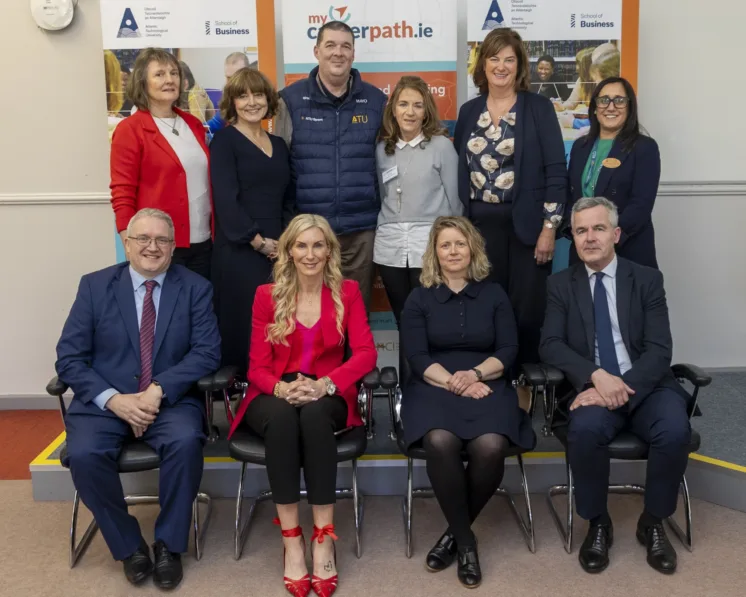
Picture caption: Back Row, L to R: ATU staff Celene Dunphy, Clodagh Geraghty, Declan Hoban, Veronica Beirne, Caroline Clarke, Programme Chair, ATU HRM programme, Shemeem O’ Toole. Front row, L to R: Michael Gill, ATU Head of Dept, Michelle Murphy, Director, Collins McNicholas Recruitment and HR Services Group, Dr Michelle O’Sullivan, Associate Professor, Department of Work and Employment Studies, University of Limerick, and Dr Seamus Lennon, Head of the ATU Galway-Mayo School of Business.
For media enquiries, contact:
Regina Daly
Communications and Press Officer
Tel: 087 961 8355
E: regina.daly@atu.ie