
Courses
Education (Technology and Construction)
Bachelor of Science (Honours)
Course Details
| CAO Code | AU686 |
|---|---|
| Level | 8 |
| Duration | 4 Years |
| CAO Points | NEW |
| Method of Delivery | On-campus |
| Campus Locations |
Connemara
Galway City – Wellpark Road |
| Mode of Delivery | Full Time |
| Work placement | Yes |
Course Overview
The Bachelor of Science (Honours) in Education (Technology and Construction) is an innovative teacher education programme designed for students who are passionate about teaching, design, technology, engineering, construction and making. Combining specialist subject knowledge with professional teacher education, the programme prepares graduates to become qualified post-primary teachers of Technology and Construction Technology.
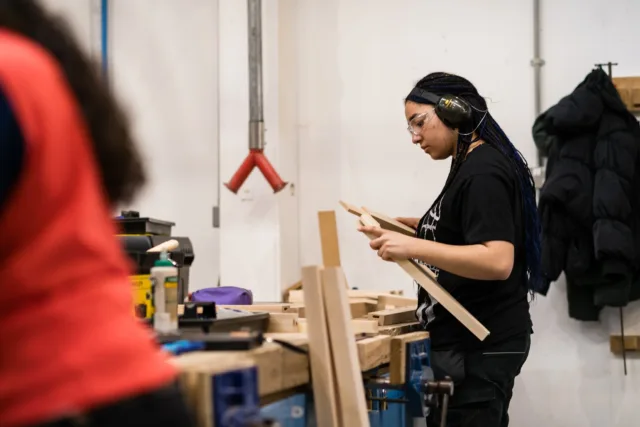
Students study Year 1 and Year 2 in ATU’s Connemara campus and Year 3 and Year 4 take place in the Galway City, Wellpark Road campus. Students develop practical and creative skills in areas such as product design, materials processing, manufacturing systems, construction technologies, CAD/CAM, electronics, digital technologies, design communication and the built environment. Alongside these technical skills, students learn how to plan, deliver and assess engaging learning experiences for young people in modern and inclusive post-primary classrooms.
A key strength of the programme is its focus on STEM and STEAM education, blending creativity, innovation and problem-solving with technical expertise. Students benefit from access to specialist workshops, manufacturing facilities, digital laboratories and industry-standard equipment while gaining a strong understanding of contemporary educational practice.
Core education and professional studies modules will support student teachers in developing their teaching philosophy and subject-specific pedagogical skills. School placement is a major feature of the programme, accounting for 25% of the degree. Students complete approximately 30 weeks of structured placement across four years, beginning with classroom observation and progressing to extended independent teaching blocks in post-primary schools. This provides invaluable real-world experience, mentoring from experienced teachers and opportunities to build professional networks.
Graduates will be qualified to teach Leaving Certificate Technology and Construction Technology, as well as Junior Cycle Applied Technology and Wood Technology. They will also develop competencies in Graphics, providing additional teaching flexibility and excellent employment prospects. This combination of teaching subjects is highly relevant to the growing demand for STEM, construction and technology education in Irish schools.
Teaching Council accreditation assures students, parents and employers that the programme meets national standards for teacher education, professional practice and school placement. It confirms that graduates have achieved the subject knowledge, teaching competencies and professional skills required to enter the teaching profession in Ireland and progress confidently into their careers as educators.
Course Details
Year 1
| Semester | Module Details | Credits | Mandatory / Elective |
|---|---|---|---|
| Year |
Academic and Professional SkillsThe aim of this module is to develop academic and professional development skills for student success in higher education and beyond. This module combines online learning activities and small group workshops to focus on areas such as academic writing and integrity, creative thinking, problem-solving, time management, communications, group work, technology, innovation and presentation skills. Learning Outcomes 1. Apply appropriate tools and principles to optimise the learning experience. 2. Develop self-reflection practices for individual and group-work activities. 3. Develop academic writing skills, recognise different information sources and apply the principles of academic integrity. 4. Assess a variety of professional communication practices and digital tools and apply to problem-solving. 5. Consider how the chosen discipline has a responsibility to wider society. |
05 | Mandatory |
| Year |
Projects 1This module, Projects 1, integrates the core areas of design, making and digital manufacture in the context of furniture related products. Learners are taught from first principles and establish a level of accuracy and proficiency required for the production of creative and high quality pieces. The module will be process led in order to help learners build competence in their use of the design process and the application of both traditional and modern woodworking techniques. Learning Outcomes 1. Develop through questioning and lecturer demonstrations a defined level of work quality and aspire to achieve this. 2. Competently produce high quality components and finished pieces of furniture through the organisation and use of essential hand skills, power tools and basic traditional and digital machining techniques. 7. Value the importance of appropriate furniture design and making techniques in the manufacture of high quality gallery standard furniture. |
15 | Mandatory |
| Year |
Design Process 1This module introduces students to the design process, beginning with an analysis of the requirements of a design brief, leading on to the development of creative solutions to a design problem. This will be conducted in parallel with analysis of existing products and design in context, to the presentation of design concepts. To achieve this, the module aims to provide students with a foundation in the drawing and visual skills necessary to effectively develop and communicate design ideas, through freehand sketching and a range of drawing techniques and media appropriate to the design process. This module is studio based and therefore practical by nature. To inform their practical work students will be taught how to appreciate design in the context of historical and contemporary precedents, as well as being introduced to circular design and th eco-design process. Work undertaken by students of this module will be linked with the module Projects 1. Learning Outcomes 1. Evaluate a design brief and apply the design process to generate ideas and solutions to given problems 2. Produce sketches appropriate to the design process 3. Analyse and evaluate existing products 4. Createpresentations for the purpose of visually communicating design ideas 5. Understand and appreciate design in an historical, contemporary and environmentally sustainable context. |
05 | Mandatory |
| Year |
Materials and TechniquesThis module will allow learners to explore a variety of natural and manmade materials and their associated processing techniques appropriate to the furniture industry. A strong emphasis will be placed on the learners understanding of wood, and its related composites. Characteristics, properties, joinery and finishing techniques alongside traditional and modern processes will be addressed. Other materials to be introduced will include metal, glass and plastics. Active learning will be applied through experiential labs to help students explore these materials and processes in a hands-on fashion. Sustainability issues will be addressed in the context of the materials and practices mentioned above. Learning Outcomes 1. Identify and classify wood using basic scientific analysis and justify species selection in the manufacture of given components or products |
10 | Mandatory |
| Year |
Technical GraphicsIn this module the principles of Technical Graphics are introduced to the learner. The core ares of study include the theorems and constructions of panier geometry along with the descriptive geometry of solid objects. The material will be presented to the learner through the duel lenses of graphical communication and its associated graphical code and practices as well as developing visual problem-solving techniques and skills. Learning Outcomes 1. Demonstrate an understanding of the principles of Orthographic Projection and Axonometric Projection to represent given objects both in multi view and pictorial form. 2. Create detailed workingdrawings to represent design ideas and solutions consistent withInternational Standards (ISO) and best practice. 3. Apply his/her knowledge of the theorems and constructions of Plane Geometry to the solving of problems posed. 4. Implement a graphical understanding of theprinciples of True length andTrue shape to the surface development of regular solids. 5. Develop his/her visuo-spatialskills to aid the visualisation of and manipulation of real and represented objects. 6. Read and understand what is represented graphically and take what information is needed from a drawing. 7. Apply the knowledge he/she has acquired to thepedagogical context required as a second level educator. |
10 | Mandatory |
| Year |
School Placement 1School Placement 1 gives students an introduction to foundational educational theory and its application in the classroom. Students participate in a series of peer teaching and/or microteaching exercises, with direction given on the development of lesson plans and teaching aids. Students also attend a primary or secondary school for one full week, as an observer and/or assistant teacher, and reflect on the experience in the context of practitioner/action research (AR). The module is delivered using a blended learning approach. As a requirement for commencing School Placement students complete TUSLA childcare e-Training, undergo Garda vetting and are required to comply with ATU 'fitness to practice' policy. Learning Outcomes 1. Apply a foundational knowledge of theories of learning and teaching to classroom management, lesson structure and effective lesson planning. 2. Prepare and deliver a section of a lesson in a peer and/or micro teaching environment. 3. Critically reflect on lessons observed and delivered in the context of practitioner research or Action Research (AR). 4. Demonstrate Numeracy, Literacy and Differentiation strategies in teaching and learning. 5. Demonstrate competency in the use of foundational ICT and education technology software. 6. Systematically observe key teaching strategies and interventions relating to Additional Education Needs. |
05 | Mandatory |
| Year |
Manufacturing Skills 1This module introduces the theory and practice for all types of hand tools and power tools used in furniture making. Best practice in terms of tool use, set-up, health and safety and performance are established. Learning Outcomes 1. Plan and prepare for the safe operation and set up of a wide range of hand tools, power tools and machines used in the production of furniture components |
10 | Mandatory |
Year 2
| Semester | Module Details | Credits | Mandatory / Elective |
|---|---|---|---|
| Year |
Education Projects 2Learners practice and develop their bench room skills which includes the use of traditional hand tools, power tools and the classic fixed woodworking machinery. This learning is developed in project assignments through the year that are designed to allow the students to focus on a series of different skill sets required in the workshop environment. All projects have some elements of design detailing and/or problem-solving, At least one project will require students to fully design and make a wooden artefact in response to a brief. Learning Outcomes 1. Respond to adesign brief, by identifying requirements;proposing and developing solutions; planingthe making phase through to completion ofartefact/project. 2. Comprehend the principles of product research and costing as they apply to the design and manufacture of wooden artefacts. 3. Demonstrate conceptual and practical design skills in thedevelopment and articulationof creative, sustainable and innovative projects. 4. Demonstrate skill and ability to safely usea broad range of hand and machine processes to make and finish high quality artefacts of wood. 5. Develop competence in identifying, integrating and undertaking all stagesof the manufacture ofa wooden artefact. 6. Practice woodworking jointing techniques that are appropriate to the secondary school environment. |
10 | Mandatory |
| Year |
Graphics and Computer ApplicationsThis module introduces the learner to the principles and practice of 2D and 3D Computer Aided Design using modern, industry standard software and processes. Additionally, it seeks to introduce the learner to the principles and applications of plane and descriptive geometry along with the best pedagogical strategies for teaching this content in a second level school setting. In doing so, this module will facilitate learners in gaining the skills required to teach and guide second level students through a Leaving Certificate (higher level) Design and Communication Graphics Student Assignment project. Learning Outcomes 1. Efficiently apply the features of Computer Aided Design software to generate2D presentation drawings and 3D digital models of artefacts, to a professional standard. 2. Outline, and demonstrate competence with the application of, the introductory principles of plane and descriptive geometry, in a typical second level graphics classroom setting. 3. Confidently discuss and appraise strategies that could be used togeneratehigh quality solutions to the Leaving Certificate Design and Communication Graphics Student Assignment. 4. Identify, and formulate solutions to, the typical errors and issuesthat are likely to be encountered when generating 2D drawings and 3D digital models. 5. Design, create and critique high-quality teaching resources by employing the features of Computer Aided Design software along with variouspresentation tools and software. 6. Consider and carefully formulate product assembly drawings and specifications in accordance with relevant standards. |
10 | Mandatory |
| Year |
Manufacturing Skills 2This Module introduces the theory and practice of the safe set-up and operation of basic as well as more advanced wood manufacturing machinery such as CNC equipment. The concept of jig making and usage is examined and practiced. Machine tooling, feed speeds, cutter speeds and cutter block design and their relevance is explored. Best practice for Health and Safety in relation to woodworking machinery and equipment is studied. Learning Outcomes 1. Plan, organise and manage the setup and operation of a variety of woodworking machines 3. Integrate the processing capabilities of manufacturing equipment with design specifications and deadlines |
10 | Mandatory |
| Year |
Design Process 2Design Process 2 will develop and deepen students' knowledge of design from Design Process 1. Students will explore and communicate the design process though research, design contextualisation and idea generation. Freehand sketching and rendering for design will be a focus in this module. Students will be challenged to design and produce presentation layouts that communicate their design proposals. Assignments undertaken in Design Process 2 will be closely aligned with the module Projects 2. Assignments in this module will take account of subjects that students will be teaching at both Junior and Senior Cycles. Students will be encouraged to deepen their knowledge of Eco Design and the Circular Economy at all stages of their learning in Design Process 2. Learning Outcomes 1. Identify, source and compile subject focused research as a precedent to given design projects. 2. Develop and apply sketching skills to produce high qualitydrawings appropriate to the design process. 3. Prepare, plan and producehigh quality design layouts that communicate design ideas. 4. Critically evaluate and contextualise design. |
05 | Mandatory |
| Year |
Theory of Teaching and LearningThis module introduces initial teachers to theories of teaching and learning arising from the field of psychology, and sociology, that can be effectively applied in the classroom to enhance teaching and learning. Areas examined include the application of educational theory in the classroom, classroom and behavioural management, active teaching methodologies, technology and education, inclusive education, differentiated learning, child protection, and reflection. Active and problem-based learning strategies are used to engage and motivate learners and enable them to take ownership of learning. Both individual and group work is facilitated. Learning Outcomes 1. Demonstrate knowledge of foundational psychological theories relating tolearning, including debates from various psychological perspectives. 2. Explain the origin of sociology andprovide a foundationalaccount of the sociology of education. 3. Provide a comprehensive account of the theory of classroom management, including behavioural management,and the role of reflective practice in classroom management. 4. Show how to integrate differentiation and inclusion strategies into teaching and learning. 5. Identify key areas of Child Care legislation and practice relevant to post-primary schools |
05 | Mandatory |
| Year |
School Placement 2The School Placement 2 module prepares student teachers for their school placement in year 2. It is based upon the four pillars of lesson planning and preparation, classroom performance, including pedagogical competence, technical competence and reflective practice. As part of this school placement students are required to spend three weeks in a school. The module addresses such areas as professionalism, child care, lesson planning and preparation, the proper use of teacher resources and aids, and teaching and assessment skills and methods. It facilitates reflective practice and critical thinking. It promotes design-led, innovative and creative teaching, which is student-centred and employs active learning teaching and assessment strategies. It promotes advanced and skilful use of ICT and Educational Technology. These skills are developed through a combination of in-class training, online training, and school-based application, which work together to form a consistent approach. As such, students are required to participate in all elements and display competencies linking the theoretical knowledge and how to apply it to the practical classroom. A significant amount of independent, inquiry-based research, and practical lesson planning, takes place outside the module contact hours. Students produce a professional teaching e-portfolio detailing lesson plans and critical reflections. Learners will also develop a range of teaching aids and resources to showcase on their portfolio. They will provide evidence of critical reflection in relation to peer teaching and mainstream second-level education. Learning Outcomes 1. Ethically and professionally collate evidence of practice. 2. Engage in social constructivist, collaborative learning, and problem-based learning through: active learning activities, participation in online fora, and peer reviews and discussions. 3. Critically reflect on peer teaching and school-based performances by means of structured self/peer/tutor rubric feedback and an online forum. 4. Present a professional teaching e-Portfolio incorporating: high-quality lesson plans, teaching resources and critical reflections, to Junior Cycle level. 5. Demonstrate competence in the use of ICT and educational technology in teaching. 6. Apply and evaluate theories of teaching and learning to the context of collaborative, problem-based, design-led, innovative and creative lesson planning. 7. Describe and implement good practice in the field of classroom management, including child protection, rules and routines, positive discipline and motivation strategies. 8. Systematically observe, and reflect upon, key teaching strategies and interventions relating to Additional Education Needs. |
15 | Mandatory |
| Year |
Applied Technology 1Applied Technology 1 is designed to empower learners to develop technological capabilities by engaging with a broad range of materials, software, and processing systems with appropriate health and safety practices. Learners will develop technological skills and knowledge through hands-on experiences whilst exploring CAD & CAM processing systems to solve design-based problems. Central to this module is the development of transversal competencies through a design-based philosophy, emphasising sustainability, product design, STEM, control and manufacturing systems. Learners will evolve their pedagogical understandings, providing a foundation for future advancement specific to technological knowledge, skills and dispositions. Learning Outcomes 1. promote the relevance of ethically engaging with applied technologies and its wider applications in Technology education and the technological world. |
05 | Mandatory |
Year 3
| Semester | Module Details | Credits | Mandatory / Elective |
|---|---|---|---|
| 1 |
Curriculum and AssessmentIn the Curriculum and Assessment module, students teachers clarify what is meant by the terms 'curriculum' and 'assessment'; they examine definitions and models, and their application in the classroom. Using Inquiry-based Learning (IBL) and Problem-based Learning (PBL) methodologies, students examine international trends in curriculum and assessment as well as contemporary issues in Irish curriculum policy and practice. A primary focus is to facilitate student teachers to gain an understanding of the nature and design of curricula and assessment in post-primary education in Ireland. The module affords them an opportunity to understand curriculum reform and critically evaluate curriculum choices offered at localised levels in post-primary schools. Students identify key stakeholders and appraise the role of key organisations contributing to curriculum and assessment at post-primary level. Students collaborate to develop cross-disciplinary curricular planning grids/schemes of work that incorporate creative approaches to assessment. Students also examine international trends. Learning Outcomes 1. Plan coherent, progressive and integrated teaching events and modules 2. Demonstrate an understanding of contemporary debates about curriculum developments and initiatives in second-level education |
05 | Mandatory |
| 1 |
Education Projects 3This module allows learners to develop a range of skills relevant to the teaching of the technology based subjects at second level. This involves developing a deeper knowledge of the construction industry through project work. The projects facilitate student learning in the areas of project management, model making, developing teaching aids and resources, and devising Construction Technology based briefs for second level pupils. Learning Outcomes 1. Respond to a design brief, by identifying requirements; proposing and developing solutions; planing the making phase through to completion of artefact/project. 5. Working collaboratively, estimate the work and time involved in leading a class through project work and the need for management of time and resources to ensure that the work meets the requirements. 7. Research and investigate sustainable construction methods and materials that can replace or compliment traditional construction. Highlight the environmental benefits of these methods in the context of the Construction Technology syllabus, with reference to SDG’s where possible. |
05 | Mandatory |
| 1 |
Architectural DesignThrough a combination of theoretical and practical lectures, this module aims to develop learners' appreciation of the way in which the built environment has evolved over the years. The fabric and structure of typical Irish domestic dwellings will be studied from first principles with comparisons being made between various styles, methodologies and materials. Learners will explore the current Irish planning process and the implications of documents such as the national spatial strategy, urban and rural development guidelines as well as the Irish technical guidance documents. Learners will investigate the properties of various construction materials and will learn to appreciate the importance of material selection in relation to the design and constructing of sustainable domestic dwellings. Learning Outcomes 1. Discuss the history of Irish building technology as well as architectural and craft heritage with confidence. 2. Describe the various stages and aspects associated with the built environment from the design through to the construction of a typical domestic dwelling. 3. Explore the properties of typical construction materials such as metals, woods, plastics, ceramics and composites and identify where these materials are best employed in the construction of a domestic dwelling. 4. Investigate and evaluate alternative and modern construction methods and techniques, with an emphasis on Irish domestic dwellings. 5. Compare and critique the design of domestic dwellings across a range of areas such as building layout, material use, sustainability, environmental impact and construction methods. 6. Analyse the subject material in order to devise sound pedagogical practices and develop creative strategies to teach construction related topics in a second level school setting. 7. Design, construct and confidently discuss physical and digital models of typical domestic dwelling details, in a creative and innovative manner. |
10 | Mandatory |
| 1 |
Technology Projects 2Technology Projects 2 requires learners to apply acquired skills and knowledge to deepen their understanding of technological processes and materials. The module evolves knowledge, skills and dispositions through electronics and applied control systems, processing systems, and communicative technologies. Within the module, learners are empowered to hone their pedagogical knowledge with reference to Technology classrooms in post-primary education. Learners will design, plan and create appropriate tasks/activities that demonstrate pedagogical intent that can be used to support post-primary pupils in their journey of discovery. This module is designed to develop pedagogical thinking in the areas of design and manufacture; materials technology and processing; applied electronic and control systems; information and communications technology; structural & mechanical systems; and related health and safety practices. Learning Outcomes 1. explain the impact of technology on our everyday lives and how it can contribute to personal, social and economic development. |
10 | Mandatory |
| 2 |
School Placement 3The School Placement 3 module prepares student teachers to plan and effectively deliver lessons in the technical subjects Technical Graphics and Materials Technology (Wood) or Art at Junior Certificate level. Student teachers are introduced to the various roles of the class teacher, reflective practice and practitioner or action-research in teaching and learning. Students integrate in the whole school environment while on placement in a host school. They develop a professional teaching e portfolio incorporating lesson schemes, plans, resources and reflective practices. They are required to demonstrate competence in a variety of active learning and assessment strategies. They are also trained to demonstrate technological competence through advanced use of ICT tools and educational technologies, in the context of flipped classroom teaching, blended learning and/or online learning, as required. TUSLA childcare e-Training, Garda vetting and Fitness to Practice, according to ATU policy, are requirements for commencing placement. Learning Outcomes 1. Prepare, deliver, manage and assess a series of design-led, innovative and creative lessons at Junior Certificate level. 5. Present a professional teaching e- portfolio incorporating lesson schemes, plans, resources and evidence of critical thinking and reflective practice. |
20 | Mandatory |
| 2 |
Education for Inclusivity and DiversityThis module aims to raise awareness of inclusion and diversity in education globally and nationally. By means of inquiry-based research, guest inputs, and observations (where feasible), participants' understanding of the role of global citizenship, partnership in the community, and non-mainstream educational provision will be enhanced. Learners will be introduced to the concepts of Civic Engagement and Service Learning. The theme of educational disadvantage will be examined. Participants will be provided with foundational tools of social analysis, with attention to socio-economic factors, gender, race and culture in the context of education. Learning Outcomes 1. Recognise the educational significance of multiple identities and develop skills for teaching inclusively in an increasingly diverse world. 2. Demonstrate professionalism and ethical integrity byco-creating a learningenvironment where each perspective is considered. 3. Reflect on global citizenship, from an education perspective, includinggood practices and ethical responsibilities in community education partnerships. 4. Identify key principles and good practices in civic engagement, service learning, adult education and community education. 5. Debate contemporary educational issues relating to diversity, gender, interculturalism, educational disadvantageand sustainability. |
05 | Mandatory |
| 2 |
Education StudiesBuilding upon the prior Theory of Teaching and Learning module, the Education Studies module further explores educational theory in the context of initial teacher education and training. It examines philosophical, psychological and sociological perspectives on learning, and their application to the classroom. Students develop their own unique philosophy statement, of education. The module further examines the history of education in the Irish context, with particular emphasis on technical education. Current issues in Irish education are explored including curriculum reform, intercultural education, differentiation and special needs education, universal design for learning, empathy education, and educational technology, among others. Active teaching and learning methods, and strategies for reflective practice, are both examined and modelled in module delivery. Learning Outcomes 1. Apply key principles of educational theory, in the fields of philosophy, psychology and sociology, to the development of a personal philosophy of education 2. Demonstrate theoretical and practical understandings of Reflective Practice and Action Research in the field of teaching and learning. |
05 | Mandatory |
Year 4
| Semester | Module Details | Credits | Mandatory / Elective |
|---|---|---|---|
| 1 |
School Placement 4This module facilitates students to successfully plan, teach, assess and evaluate a series of lessons at Junior and Leaving Certificate cycles. It enables student teachers to compile a fully comprehensive and professional teaching and learning e Portfolio, showcasing best sample outputs from SP1-4. The module promotes reflective practice, research, and professionalism in the practice of teaching. A large suite of professional teaching resources are developed with attention to differentiated learning and universal design for learning (UDL). Students become competent in the use of the language of reform and their subject/discipline literacy. On SP4 students engage weekly in ten hours of classroom teaching to senior level and 2 hours of school support work and/or practitioner research is also recommended. Practice-based research is supported by online supervision sessions and critical reflections. Digital literacy and practice is also enhanced. The module promotes the effective use of a variety of educational technologies, as well as blended/online pedagogical strategies and tools. The module also incorporates a ten-week peer mentoring and leadership training programme, called NEST ( Nurturing Excellence in Students Teachers ) where participants peer mentor year three students. Students are required to evidence fitness to practice, according to ATU policy, Garda vetting and e-TUSLA training prior to commencement of SP4. Learning Outcomes 1. Successfully plan, teach and evaluate a series of lessons at Junior and Leaving Certificate cycles and assist peer to do likewise. 2. Demonstrate competence in a broad range of generic teaching skills, particularly core skills (planning, implementation, evaluation and reflection), methodologies (design-led, problem-based, and co-operative learning) and mentoring skills (peer mentoring). 3. Undertake the various roles of the teacher and integrate successfully and professionally into the entire school community 5. Demonstrate high levels of skill in the advanced use of ICT tools and educational technologies 7. Apply numeracy, literacy, graphicacy and oracy strategies to classroom teaching. 9. Critically reflect on the implementation of research-based Additional Education Needs teaching strategies at Junior Cycle and Senior Cycle levels, applying selected models of reflection, and multimedia approaches. |
20 | Mandatory |
| 2 |
Professional StudiesThis module explores professionalism in teaching. Students become informed about the roles and requirements of key educational stakeholders and they examine codes of professional conduct or practice, both nationally and internationally. They become fully familiar with the landscape of Initial Teacher Education (ITE) and future professional teaching pathways. Areas such as educational leadership & management, evidence-based/research-based practice, social justice education, school development planning, and preparing for interview, are explored. The skill of critical thinking is enhanced through the module, through tutorial discussions, debates, discussions and a mock interview. The mode of delivery is active learning: students engage in tutorial discussions and debates, conduct and present a small-scale social justice project, undergo a mock job interview and present one example of their innovative teaching at an open ATU conference. Learning Outcomes 1. Debate current educational trends and policies relating to initial teacher education and post-primary teaching, identifying the main contributors to policy formulation. 2. Collaboratively plan, implement and present a social justice educational project. 3. Critically assess whole school professional codes of conduct, roles and responsibilities. 4. Professionally disseminate creative and innovative teaching, learning and assessment strategies. 5. Provide evidence of a comprehensive knowledge of the professional responsibilities of post-primary teaching, including subject specialist delivery, school planning and whole school responsibilities. 6. Demonstrate subject-discipline expertise and whole-school professional knowledge in the context of an oral interview |
10 | Mandatory |
| 2 |
Building Services and TechnologyIn this module, learners will examine the design and integration of various service and control technologies typically found within domestic buildings in Ireland. This will include a study of the most up-to-date (including alternative) construction methods. Additionally, the module will explore the design, analysis and selection of various building materials as well as issues relating to planning for sustainability, the structure of the construction industry, safety in the construction industry as well as broader construction issues. Through theoretical and practical studies, this module will introduce learners to the subject matter in a hands-on, practically applied and interesting manner. Learning Outcomes 1. Be capable of formulating a cogent critique of the various services and environmental control technologies typically incorporated into the construction of a modern domestic dwelling. 2. Be proficient with the interpretation and application of industry standard regulations and formulae in the solving of problems associated with heat, light, air and sound calculations in domestic dwellings. 3. Confidently interpret, discuss and draw conclusions from such calculations to allow for the informed design, selection and installation of suitable environmental control systems within domestic dwellings. 5. Analyse the topic of domestic building services in the context of establishing the best pedagogical practice anddeveloping highly creative strategies to teach the material in a second level school setting. |
05 | Mandatory |
| 2 |
Advanced TechnologyAdvanced Technology uses an interdisciplinary approach which encourages the integration of prior learnings and experiences in the teaching and learning of Technology education. Learners will be supported to advance individual agency through the creation of an artefact(s) that solves a design-based challenge. Within this, learners will have a further opportunity to develop and showcase technological capability by engaging and leading learning through a broad range of materials, processes and control systems. The Advanced Technology project(s) should showcase learners' individual connections, motivations, skills and knowledge through seminal work(s) as a contribution to inform future practices within Technology education. Learning Outcomes 1. unpack, analyse and interpret a complex project brief that includes the justification of design decisions through the appropriate use of materials, processes and systems relevant to Technology education. |
15 | Mandatory |
| Year |
Practitioner ResearchThis module facilitates learners to integrate prior learning from programme educational theory modules, subject specialist modules and school placement modules in the context of practitioner research. Learners are introduced to best practice library research, literature analysis research and primary research theory and practice. They learn to distinguish between various educational research methodologies, including documentary analysis research, case study research and action research. The concept of triangulation is explored as well as data gathering methods, data analysis methods, and research validation and reliability. Finally, principles of research ethics are explored, including informed consent, anonymity and power relations in practitioner research relationships. Learning Outcomes 1. Construct a concise practitioner research proposal that specifies the research question and the research project design. 2. Systematically evaluate literature in a specified field, employingadvanced library database research. 3. Distinguish between different educational research methodologies, including documentary analysis, case study and action research. 4. Apply triangulation in the context of a small-scale group primary practitioner researchproject. 5. Systematically analyse practitioner research findings and discuss the significance of the findings, in dialogue with literature. 6. Disseminate research findings in the form of aresearch presentation. |
10 | Mandatory |
Progression
Graduates can progress to masters degrees, postgraduate diplomas and research programmes in education, teaching and learning, design, technology, construction, leadership and related fields in Ireland and internationally.
Build Your Prospectus
Explore the courses that interest you with MyATU Prospectus. Choose the courses and information you want to see, then create a personalised prospectus that fits your interests and goals.

Entry Requirements
| Leaving Certificate Entry Requirement | 6 subjects at O6/H7 which must include: – 2 subjects at H5 – English or Irish at O6/H7 – Maths at O6/H7 – Construction Studies/ Construction Technology or Technology or Applied Graphics & Design/ Design & Communication Graphics or Engineering at H5 |
| QQI/FET Major Award Required | One of the following awards: 5M5010 – Construction Technology 5M1981 – Creative Craft 6M4989 – Architectural Technology & Design 5M1940 – Computer Aided Design 5M2012 – Furniture Design & Making 5M3635 – Pre-Teaching & Education Studies |
| Additional QQI/FET/ Requirements | 5M5010 requires 3 Distinctions 5M1981 requires 3 Distinctions 6M4989 requires 3 Distinctions 5M1940 requires 3 Distinctions 5M2012 requires 3 distinctions 5M3635 requires 3 Distinctions |
| GCE/ A-level/ GCSE Entry Requirement | 6 distinct recognised GCSE/A-level subjects which must include: A-level in Technology or Design & Communication Graphics or Engineering at Grade C 1 other A-level at Grade C and 4 other subjects at GCSE-level Grade C which must include: – English or Irish – and Maths |
| Garda Vetting | Entrants to this programme may be required to undergo vetting by An Garda Síochána. |
| Fitness to Practice | Students must meet the Fitness to Practice standards outlined in the ATU Student Fitness to Practice Policy. |
Fees
Total Fees EU: €2,350
This annual student contribution charge is subject to change by Government. Additional tuition fees may apply. Click on the link below for more information on fees, grants and scholarships.
Further information on feesCareers
Graduates are primarily prepared for careers as post-primary teachers of Technology and Construction Technology, with eligibility to register with the Teaching Council. Additional opportunities exist in curriculum development, education support services and training roles. The programme’s strong foundation in construction, design, manufacturing and digital technologies also opens pathways into industries such as furniture and interiors, product design, research and development, educational technology and the wider creative and construction sectors.
Further Information
Contact Information
Contact cao@atu.ie to find out more about the programme or campus you plan to join.
Contact admissions@atu.ie for enquiries about your application.
For International (Non-EU) enquiries, please contact international.galwaymayo@atu.ie
Contact admissions@atu.ie for enquiries about your application.
For International (Non-EU) enquiries, please contact international.galwaymayo@atu.ie
