

Courses
Culinary Arts, Professional Chef Programme
Higher Certificate in Arts
Course Details
| Course Code | GA_OCPPG_C06 |
|---|---|
| Level | 6 |
| Duration | 3 years |
| Credits | 120 |
| Method of Delivery | On-campus |
| Campus Locations | Galway City – Dublin Road |
| Mode of Delivery | Part Time |
| Work placement | Yes |
Course Overview
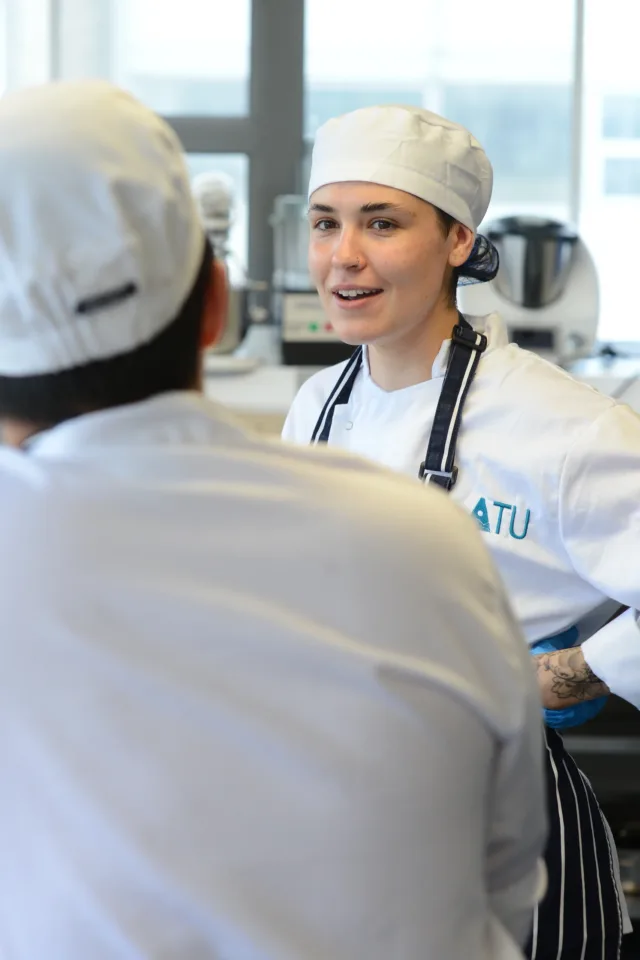
This course is designed for individuals who wish to upskill to a formal culinary arts qualification while maintaining a job in a professional kitchen. Two days per week will be spent in College with occasional online classes to support learning. The course will provide students with the essential knowledge, skills and competence necessary for a career as a professional chef. This will be achieved in practical kitchens, restaurant and laboratories, through the development of essential practical skills, required of modern day culinary professionals working in a contemporary kitchen.
Modules in the course include pastry and baking, sustainable food preparation, food production and service, introduction to nutrition and food safety, digital technologies and employability preparation. Students will learn about modern global sustainable food systems, while working with and recognising the wonderful food produced on the island of Ireland.
This programme has been approved for part-time SUSI funding for learners commencing in September 2026. Applicants who wish to apply for SUSI funding will note the programme referred to as Higher Certificate in Culinary Skills on the SUSI website, application form and award letter.
Course Details
Year 1
| Semester | Module Details | Credits | Mandatory / Elective |
|---|---|---|---|
| Year |
Sustainable Food PracticesThis module is designed to develop essential culinary skills and will focus on teaching student chefs how to think and act sustainably for kitchen efficiency and to embed an ethos of sustainable thinking in young chefs. Food will be sourced from a sustainable, local supply chain to allow students understand the essential fundamentals of green procurement. Learning Outcomes 1. Develop classicand contemporaryculinary skills andtechniques. 2. Demonstrate a competent level of skills, food safety and theoretical knowledge in relation to sustainable food practices from farm to fork. 3. Apply the principles of dish compilation, quality control and costing. |
10 | Mandatory |
| Year |
Introduction to Food Science and NutritionThis module will provide learners with the fundamental knowledge of numerical procedures used in food science and nutrition, the theoretical knowledge underpinning microbiological safety of food the systems to control it. The module will also introduce the students to the basic food biomolecules, the nutritional composition of foods, energy requirements and will help to develop the ability to apply the principles towards creative menu planning, suitable for healthy and sustainable dietary approaches. Learning Outcomes 1. Demonstrate knowledge of numerical procedures and ability to solve equations encountered in food science 2. Demonstrate a working knowledge of the macro- and micronutrients and their composition in the major food groups 3. Identify the principles of microbiology and hygienic work practices as they relate to the provision of safe food |
10 | Mandatory |
| Year |
The Art of Pastry, Baking and Desserts 1This module will enable learners to demonstrate the skills required for pastry, bakery and desserts. The learner will be provided with the opportunity to practice pastry, bakery and dessert skills required for a sustainable contemporary professional kitchen. Learning Outcomes 1. Identify ingredients, equipment, techniques and the range of artisan, seasonal and locally available produce necessary for the production of pastry, bakery and dessert products. 2. Explain the scientific principles underpinning all the processes used in the pastry kitchen. 3. Utilise the processes and techniques necessary to produce a range of pastes, breads, sponge products, hot and cold desserts. 4. Demonstrate practical skills based on sustainable principles, health and safety, and food safety guidelines. 5. Apply cost and quality control procedures as they relate to the production of pastry products. |
10 | Mandatory |
| 1 |
Academic and Professional Skills (SC:HC)The aim of this module is to develop academic and professional development skills for student success in higher education and beyond. This module combines online learning activities and small group workshops to focus on areas such as academic writing and integrity, creative thinking, problem-solving, time management, communications, group work, technology, innovation and presentation skills. Learning Outcomes 1. Apply appropriate tools and principles to optimise the learning experience. 2. Develop self-reflection practices for individual and group-work activities. 3. Recognise different information sources and apply the principles of academic integrity. 4. Assess a variety of professional communication practices and digital tools and apply to problem-solving. 5. Consider how the chosen discipline has a responsibility to wider society. |
05 | Mandatory |
| 2 |
Preparation for Work PlacementThis module will prepare the student for a summer work placement in a professional establishment of their chosen industry. Learning Outcomes 1. Apply critical thinking and active research skills to source work placement opportunities. 2. Demonstrate the principles of proper workplace etiquette. 3. Construct effective time management skills 4. Create professional documents for work placement (including CV, cover letter and online profiles) 5. Network effectively online and in person |
05 | Mandatory |
Year 2
| Semester | Module Details | Credits | Mandatory / Elective |
|---|---|---|---|
| Year |
Culinary Skills and ServiceThis module will provide the learner with the knowledge and skills of the principles and practices of culinary/restaurant operation. The module will develop techniques and skills essential to professional cookery and service in a sustainable manner. Learning Outcomes 1. Demonstrate knowledge skillsand fundamental theoryin relation to the professional kitchen/restaurant. 2. Apply the principles of dish compilation, quality control, sustainability, waste managementand cost control. 3. Demonstrate technicalwork practices, teamwork and understand the importance of an efficient, communicative relationshipbetween restaurant and kitchen teams. 4. Apply professional hygiene and safety practices in accordance with Food Safety Authority of Ireland (FSAI) training standards. 5. Apply customer service in the practical delivery of restaurant service. |
10 | Mandatory |
| Year |
The Art of Pastry, Baking and Desserts 2This module will enable learners to demonstrate with confidence and creativity the skills required for pastry, bakery and dessert production. Learners will design and create modern and innovative pastry, bakery and desserts, being cognisant of sustainability and current national and international trends. Learning Outcomes 1. Utilise the necessary skillsto produce a range of creative pastry, bakery and dessertproducts. 2. Employ modern techniques to adapt classical desserts and confectionery products to contemporary styles. 3. Apply innovative concepts of composition, taste, design and texture to ‘allergy-aware’ pastry, bakery and desserts. 4. Discuss current developments and trends in the bakery and pastry industry with particular focus on sustainability and ethical sourcing of commodities |
10 | Mandatory |
| Year |
Food Science and TechnologyThis module will provide the learner with the basic theoretical knowledge on physical and chemical characteristics of food, the fundamentals principles of food science, which underpin processes and operations in food manufacturing and in professional catering operations.The module will also investigate the scientific principles behind traditional and novel practices in food preparation, processing, preservation, packaging. Learning Outcomes 1. Demonstrate an understanding of the scientific principles applied to food transformations and food processing 2. Demonstrate the knowledge of the basic concepts of chemistry and physics applied to food 3. Evaluate the effects of food processing and technology on chemistry, flavour and nutritional attributes of foods 4. Explore the current and future trends in food science and technology 5. Explain the concept of quality control and its importance in the context of food production 6. Describe the key microbiological aspects impacting food safety in a food manufacturing and catering environment |
10 | Mandatory |
| Year |
Information and Digital TechnologiesThis aim of this module is to: Equip students with the skills and technological ability to use personal computing devices; bring the students to a practical level of competency in Information Communication Technology tools, including ATU Student Online Resources, local and cloud file management, accessing and sharing, and effectively engaging with the LMS. Outline mutual responsibilities and provide a framework for managing communication and behaviour in a digital world. Establish a practical proficiency and a theoretical understanding of the fundamentals of word processing, presentation software, spreadsheet and database computer applications and how they are structured, organised, and used to manage business information. Collaborate and integrate with additional apps, services and tools to help students work, learn, organise, connect, and create. Learning Outcomes 1. Demonstrate competence in running and managingpersonal computing devices. 2. Manipulate file systems to efficiently organise files and folders in a networked and cloudbased storage solution/environment. 3. Demonstrate the ability to use a word processing application to create, edit and formatprofessional documents and improve writing with built-in intelligent features. 4. Display competence in using presentation software to create, edit, format and animate professional, polished and visually impactful presentations. 5. Use appropriate spreadsheet software to plan, create, develop, chart,and navigate multiple worksheets and workbooks. 6. Define, build, query, and maintain databases, database objects, and relationships using appropriate database software. 7. Refine and maximise efficiency using the Internet and relevant web-based resources. 8. Complete and Earn Digital Education Badges via The Microsoft Education Centre. |
10 | Mandatory |
Year 3
| Semester | Module Details | Credits | Mandatory / Elective |
|---|---|---|---|
| Year |
Creative Cooking and ServiceThis module incorporates lecture and student led menu based practical classes and food service. Students will organise, plan and deliver a range of sustainable menus in a realistic working environment. Students will be encouraged to reflect on their own skills' development. Peer review is an integral component of this module. Learning Outcomes 1. Apply innovative creative cookery techniques,practical skills and project management procedures 2. Develop and designa student led menu 3. Supervise the kitchen, demonstrating kitchen and food safety management roles 4. Apply cost and quality control procedures as they relate toa sustainable professional kitchen. |
10 | Mandatory |
| Year |
Classical and Global Cuisine for the Contemporary KitchenThis module is designed to give learners the opportunity to develop expertise and creative ability in the areas of classical and contemporary cuisine. It will enable the learner to compare and contrast classical and contemporary styles of food production and analyse the current trends within the culinary environment. Students will build on and consolidate the skills and knowledge gained in year one and on placement. This module challenges students to explore through research and practical application aspects of the original dish while making it indicative of their own culinary style. Learning Outcomes 1. Identify and evaluate ingredients, in relation to sustainability and sensory quality. 2. Produce a range of classical and contemporary dishes incorporating international influences. 3. Investigatemodern global trends and influences in the contemporary kitchen. 4. Identify cost factors andmenu planning considerations in the production of all dishes. |
10 | Mandatory |
| 1 |
Modern GastronomyThis Module provides the learner with an understanding of gastronomy, international influences and the development of gastronomy in a historical context The module will explore the development of global and irish gastronomy and its impact and importance in food tourism and sustainability. Learning Outcomes 1. Identify key developments and indviduals in the historical development of Gastronomy 2. Evaluate the importance of Gastronomy in the development of Tourism. 3. Explore the links between International gastronomy and influences on the development of contemporary Irish Food. 4. Evaluate the political, technological, socio-economic, ethical issues in the development of sustainable gastronomy. 5. Develop an awareness of the emerging trends and challenges in the food industry. |
05 | Mandatory |
| 1 |
Food for Health and WellbeingThis module investigates how a holistic approach to health is key to fully appreciating the importance of food for health and well-being. It also offers case-studies, experiential learning practices, and personal development techniques to broaden a students understanding of the role of food for health and well-being, as well as giving the student a meaningful experience of how to create food that is life-enhancing. This module explores how health shapes our relationship with food; The food we produce, the type of agriculture we favour, the way in which food is cooked and eaten and how we socially and culturally engage with food and food production. The module examines food and our minds, food and our body, food and our emotions. Learning Outcomes 1. Describe the meaning of health and how the definition of health shapes our relationship with food. 2. Identifythe role of food for health and well-being and how to createfood that is life-enhancing. 3. Associate good health with agriculture,food production methods andthe way in which food is cooked and eaten. 4. Analyse the impacts of food on our minds,our body and our emotions. |
05 | Mandatory |
| 1 |
Workplace CultureThis module is designed to empower students to become self-aware of their personal health and well-being and how to work positively and creatively in a team. They will learn about the positive impacts of diet, exercise, stress management and mindfulness. It will detail potential negative occurrences if work/life balance is not maintained. This module explores the factors that contribute to a respectful working environment, embracing equality, diversity and inclusion. Learning Outcomes 1. Identify the factors contributing to good health and well-being for employees in their work environment 2. Understand the interconnectivity of many factors in the development of a positive workplace culture and examine factors that impact both negatively and positively on mental health. 3. Practice mindfulness and demonstrate techniques to manage stress 4. Develop creativity in a mindful environment |
05 | Mandatory |
| 1 |
Placement Reporting and Reflection 1The placement module provides learners with the opportunity to develop an awareness of the working environment and to apply theoretical and practical knowledge gained during their placement. The purpose of reflection is to provide for the possibility of learning through experience. The aim of this module is for the learner to reflect on their placement and to review it under guidance from academic staff. Learning Outcomes 1. Explain the importance of teamwork as part of a management approach to improve quality and performance to meet customer expectations. 2. Identify how work is planned and organised at different levels within an organisation 3. Outline and reflect on the application of relevant skills and knowledge including the identification of strengths and weaknesses in a self-reflective capacity. 4. Discuss linkages between theory and the real-life, work-based environment. 5. Describe the placement experience, utilising good communication skills. |
05 | Mandatory |
Recommended Study Hours per week
16 -18 hours per week in person contact. Students are expected to undertake self-guided study and class preparation in advance of each week.
Examination and Assessment
All practical classes are assessed continuously throughout the year, theory modules will have a combination of continuous assessment and end of year examinations.
On-Campus Attendance Requirement
Mandatory two days per week on campus with occasional field trips.
Progression
Graduates from the Higher Certificate can progress on to complete a degree in Culinary Arts or Gastronomy.
Download a prospectus
Entry Requirements
5 subjects at O6/H7 which must include:
English or Irish at O6/H7
Maths not required
Must have at least two years post leaving certificate work experience.
Fees
Fees for this part-time programme may be covered under the SUSI fee scheme for eligible candidates.
Further information on feesCareers
A career in culinary arts can offer a wide and varied portfolio of opportunity to graduates from professional kitchens in restaurants, bars, hotels and hospitals to retail opportunities and roles in large food service and hospitality management companies. Graduates who progress on to the degree can seek roles in food manufacturing companies and food product development.
As this course incorporates a work placement, our dedicated links office assists students and graduates with seeking roles with many of our industry partners. However, if a student already has employment, this will qualify as a work placement.
Further Information
Application Closing Date
This course has now closed for applications for September 2026.
Start Date
September 2026
Who Should Apply?
This part-time course is designed for individuals who are already working in professional kitchens and wishing to get a formal qualification combining study while earning. It may also suit a kitchen porter/catering assistant looking to upskill to commis chef level.
Contact Information
Admissions Office