
Courses
Researchers uncover safer and long-lasting batteries for smartphones
Lithium-ion batteries are among the most widely used energy sources in portable electronic devices, including mobile phones, laptops, watches, and portable power banks. However, their safety risks and limited lifespans remain major challenges.
One of the biggest dangers is thermal runaway- a chain reaction where a battery overheats and can catch fire or even explode. When temperatures rise above 80°C, uncontrolled chemical reactions can occur inside the battery. A well-known example happened in 2016, when a major smartphone brand had to recall devices after battery fires caused by thermal runaway.
To tackle these problems, researchers at the Nanotechnology and Bio-Engineering research group at Atlantic Technological University (ATU), Ireland, have recently made two significant discoveries that could pave the way for safer, more durable lithium-metal batteries. This major discovery was made by ATU PhD researcher Keith Sirengo and a team of researchers supervised by Prof. Suresh C. Pillai at ATU. This research is carried out in collaboration with Dr Libu Manjakkal of Edinburgh Napier University, UK. These works were recently published in the American Chemical Society Journal, The Journal of Physical Chemistry C, and the Elsevier Journal Composites Part B: Engineering.
Like all rechargeable batteries, lithium metal batteries are built with an anode, cathode, separator, and electrolyte. But their performance is often limited by an unstable layer that forms on the anode’s surface, known as the solid electrolyte interphase (SEI). This layer is supposed to protect the battery, but during charging and discharging, it can repeatedly crack and reform, wasting lithium and electrolyte in the process. Over time, this leads to poor battery life, reduced performance, and, in some cases, the formation of dangerous growths called lithium dendrites that can pierce the separator and cause short circuits or fires.
ATU researcher Keith Sirengo found that using a unique imidazolium-based ionic liquid, specifically 1-Butyl-3-methylimidazolium tetrafluoroborate, in the electrolyte significantly extends battery life. This ionic liquid facilitates the formation of a stable protective layer composed of lithium fluoride (LiF) on the anode. The layer lowers resistance, allowing lithium ions to move more easily, and thus making the battery both safer and longer lasting.
Keith and team have discovered that ageing the battery, letting it process for about 16 days, encourages the formation of a stable “solvent-anion complex.” This process reduces voltage losses and improves the battery’s ability to recharge efficiently. The method is simple, cost-effective, and suitable for large-scale production.
The study also found that while this approach creates a more stable SEI (Solid Electrolyte Interphase), it can slightly reduce other properties, such as ionic conductivity and overall efficiency. Despite ongoing challenges with cathodic stability, this work highlights the potential of imidazolium-based additives to enhance cycling performance. The team believes that future research should focus on developing advanced electrolyte formulations that strike a balance between stability and high performance.
“Electrolyte formulation and lithium-metal protection are essential for unlocking the full potential of high-energy lithium-metal batteries in terms of safety and longevity,” said Keith Sirengo, the lead researcher.
The use of ionic liquids enables a unique self-repairing mechanism that spontaneously heals the lithium surface during cycling- addressing the breaking and reforming processes typically observed in lithium metal. Keith added that “unlike the expensive aging process in traditional Li ion batteries, which consumes a lot of energy, our second approach presents a straightforward and cost-effective aging strategy. In doing so, this approach transforms lithium’s inherent reactivity from a challenge into an advantage, thereby reducing the cost associated with the energy needed to trigger aging in traditional graphite-based batteries.”
Prof. Suresh C. Pillai, Principal Investigator of this project and PhD supervisor, said,
These findings show that optimising these factors not only enhances the stability of the solid–electrolyte interphase (SEI) but also contributes to safer and longer-lasting battery operation. Keith’s work highlights how targeted electrolyte engineering can address some of the most persistent challenges in lithium metal batteries, including dendrite formation, limited cycle life, and safety risks. Ultimately, this work emphasises the importance of understanding and controlling interfacial reactions at the molecular level to unlock the full potential of next-generation energy storage systems.
Dr Brendan Jennings, ATU Chief Officer Research, Innovation and Engagement, highlighted the significance of the findings.
This invention by Keith, Suresh and his team demonstrate that carefully designed electrolyte systems can overcome several long-standing limitations of lithium-metal batteries, particularly safety concerns and limited cycle life. Moreover, this collaboration reinforces ATU’s commitment to advancing applied research and promoting innovations that generate meaningful, real-world impact for next-generation energy technologies.
This story is part of Bright Minds, Big Impact, a series highlighting ATU’s research excellence and the people driving meaningful change.
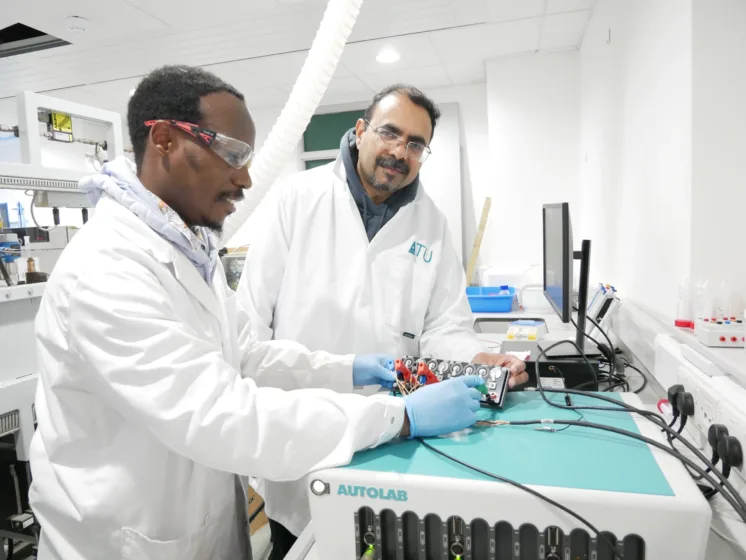
Photo caption: The lead researcher, Keith Sirengo, and Prof. Suresh C. Pillai, Principal Investigator of this project and PhD supervisor, Atlantic Technological University (ATU).
Ivana Hanjs
Communications Officer
Tel: +353 89 963 9559
E: ivana.hanjs@atu.ie