
Courses
Evidence-based data crucial in food nutrition debate and public discourse – key message at ATU-hosted “Big Nutrition Debate”
Nutrition misinformation, ultra-processed food, artificial intelligence (AI), sustainability, and global food systems were among the major themes explored at the “Big Nutrition Debate” hosted by NutriPD on the Atlantic Technological University (ATU) Galway City campus on Friday, 13 February.
NutriPD – a National Forum funded initiative led by Dr Lisa Ryan at ATU – focuses on strengthening and future‑proofing the nutrition profession in Ireland through community building, enhanced professional development opportunities, shared learning, and knowledge exchange.
The programme featured four keynote presentations from leading experts in nutrition, dietetics, and food science, together with two live student debates. Debate teams represented each province and included undergraduate nutrition science students from ATU, University College Cork, Munster Technological University, South East Technological University (SETU), Ulster University, Queen’s University Belfast, Technological University Dublin (TU Dublin), and Technological University of the Shannon (TUS). In total, the event brought together more than 100 professionals working across nutrition, dietetics, health, and sports science, alongside undergraduate and postgraduate nutrition students from across Ireland, creating a vibrant forum for discussion, learning, and professional exchange.
Opening the event, Dr Orla Flynn, ATU President, and Dr Lisa Ryan, Head of the new ATU School of Health, Sport Science and Nutrition, spoke about the importance of evidence‑based nutrition knowledge and communication across multiple disciplines. They highlighted how the newly established school supports cohesive messaging to promote health across the west and north‑west.
Orla Walsh, Registered Dietitian (RD) and media contributor, addressed the growing challenge of nutrition misinformation, explaining how misleading content often contains incomplete or manipulated information that shapes false narratives. She emphasised the importance of collaboration across professions:
“Registered Nutritionists, Registered Sports Nutritionists, Registered Dietitians, organisations in healthcare, community, public policy, companies, and media need to come together to combat misinformation, disinformation, and mal‑information with a clear programme and a tactical plan—one that doesn’t invite online hatred. We have to make the evidence clearer in all our communications.”
Dr Cathal O’Hara, RD, research fellow at the Royal College of Surgeons of Ireland (RCSI), presented “The Future of Nutrition: AI and Digital Innovation”. He explored the emerging digital nutrition landscape, referencing the European Health Data Space, new roles in health data, and advances in language‑model technologies: “It’s very much an emerging exploratory area of research, with few domain-specific models for nutrition and dietetics and limited evidence of real world application”.
Professor Mary Ward, Ulster University, outlined issues around “Sustainability and Global Food Systems” looking at the big challenges in child malnutrition, undernutrition (stunting, wasting) and overnutrition (obesity and NCDs). “Micronutrient deficiency is a hidden hunger. According to The Lancet Global Health 2024, modelled data on population (31 countries), 5.1 billion adults are estimated to suffer from a deficit in micronutrients (55% of the world’s population). This is believed to be the tip of the iceberg as it’s based on dietary intake data, which is still only a best guestimate, despite rigour. The big challenge is to measure dietary intake with biomarker data. Producers, processors supply chain, health and nutrition policy makers and other stakeholders need to work together to make changes and address nutrition deficiency.”
Professor Ciarán Forde, Wageningen University, presented on the topic of “Processing the Evidence” and posed the question of whether there was evidence of a unique effect of food processing on energy intake and health. Prof Forde highlighted findings from the recently completed RESTRUCTURE trial (www.restructureproject.org) and showed that although many studies have concluded on a role for food processing in promoting higher energy intakes, all studies to date have been confounded by unmatched energy density and eating rates, which are a fatal flaw when attributing differences in intake to degree of processing. Instead, he emphasised that “the primary goals of food-based dietary guidance is to eliminate all nutrient deficiencies and optimise nutrient intake to minimise disease risk”.
Professor Forde concluded that: “we aim to promote an evidence-based understanding of the nutrient and behavioural drivers of diet related chronic disease and focus on the development of nutritionally balanced processed foods that mitigate against the potential risk of energy over-consumption”. The debate on processed foods is likely to evolve in the future to place more emphasis on evidence‑based guidance that promote dietary and reformulation strategies focused on nutrients rather than degree of food processing, to meet the twin goals of sustainable and healthy eating patterns.”
A highlight of the event were two live debates featuring undergraduate nutrition science students from institutions across Ireland, designed to amplify and empower the student voice. Teams debated two motions: “Is AI a threat or a support to the nutritionist’s role?” and “Should plant‑based diets be promoted as the default?”. Students presented clear, evidence‑based arguments with confidence and critical insight, reflecting the complexity and nuance of modern nutrition science. Prizes for Best Debater, Best Debate Team, and Audience Favourite Debater were generously sponsored by the Kerry Health and Nutrition Institute. The winners were: Best Debater – Aoife Lynch (UCC, Munster team); Best Debate Team – Ulster team; and Audience Favourite Debater – Robyn Park (Ulster University, Ulster team).
For more information about ATU programmes in Health, Sport Science and Nutrition, see:
- Public Health Nutrition – Atlantic Technological University
- Human Nutrition – Atlantic Technological University
- Applied Sport and Exercise Nutrition – Atlantic Technological University
- Nutrition and Food Sensory Science – Atlantic Technological University
- Public Health Nutrition – Atlantic Technological University
If you are a nutrition professional and would like to join the NutriPD Community of Practice, please contact Dr Ciara Goland (ciara.goland@atu.ie). You can also follow our NutriPD LinkedIn and Instagram pages to keep up to date with future events and activities.
Picture caption:
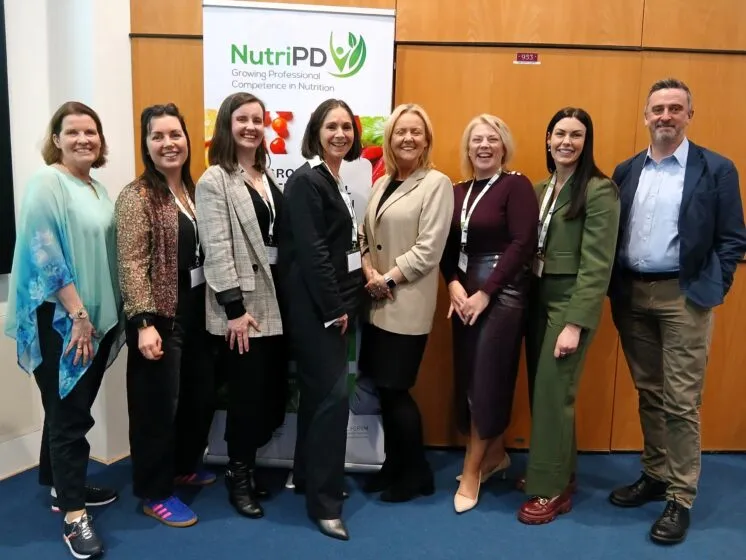
Pictured at the recent Big Nutrition Debate in ATU Galway city, L to R: Dr Aisling Aherne, Senior Nutrition Scientist, Kerry Health and Nutrition Institute; Orla Walsh, Registered Dietitian and Founder of Orla Walsh Nutrition; Dr Sarah O’Donovan, Postdoctoral Researcher ATU; Dr Aileen McGloin, Director of Nutrition at Safefood; Professor Mary Ward, Professor of Nutrition and Dietetics at Ulster University; Dr Lisa Ryan, Head of School of Sport, Health Science, and Nutrition and NutriPD Lead; Dr Ciara Goland, Assistant Lecturer ATU and NutriPD Coordinator; Professor Ciarán Forde, Professor of Sensory Science and Eating Behaviour at Wageningen University and Research.
Regina Daly, Atlantic TU Communications
Tel: +353 (0)91 742826/ Mob: +353 (0)879618355
regina.daly@atu.ie