

Courses
Ceramics Skills and Design
Bachelor of Arts (Honours)
Course Details
| Course Code | GA_ACSDG_H08 |
|---|---|
| Level | 8 |
| Duration | 3 Years |
| Credits | 180 |
| Method of Delivery | On-campus |
| Campus Locations | DCCI Thomastown, Kilkenny |
| Mode of Delivery | Full Time |
| Work placement | Yes |
Course Overview
This is a practice-led honours degree where you learn by making, specialising in production skills, clay and glaze technology, kiln theory and operation.
You will build high-level ceramics skills in the studio, supported by design thinking, research, drawing and professional practice.
You do not need previous ceramics experience. We welcome applicants with potential, curiosity and commitment. If you enjoy working with materials and making in 3D, this course can be a strong fit.
You will develop skills across making, materials and processes, including:
Wheel throwing (from core forms through to confident production)
Hand-building and mould-making, including jigger/jolly and press moulding
Clay and glaze technology, testing, and basic recipe development
Surface decoration such as slips, glazing, printing, lustres and decals
Kiln theory and operation, using electric, gas and wood-fired kilns
Teaching is mostly practical and project-based. Most assessment is through studio work. Theory, history and research support your making and help you explain your decisions. Written work increases in later years, including a final-year dissertation linked to your practice.
In year 2, you complete a work placement or live project. This helps you gain real experience, build contacts and understand professional studio practice.
In the final year, you develop a personal body of work through a major Capstone Project, alongside professional preparation and a public graduate exhibition.
Throughout the programme, visiting guest lecturers with specialist expertise provide demonstrations and lectures; this ensures the high quality of specialist education and the employability of our graduates.
Graduates often go on to work as independent ceramic designer-makers, production potters, studio assistants or technicians, craft business owners, or in gallery and retail roles in craft and design. Some progress to postgraduate study.
The course is delivered at the DCCI Centre of Excellence in Thomastown, Co. Kilkenny.
How to Apply
Applications are submitted online by clicking the Apply Now button on the course webpage.
Please complete all sections of the application form and upload all relevant information and supporting documentation. If you are unable to upload documentation, a member of our Admissions team will contact you by email to request it.
Applications are assessed and eligible applicants will be invited to an interview. At interview, you will have the opportunity to talk through a portfolio of your creative work (this may include ceramics, drawing, making, or other relevant creative work).
Shortlisted applicants will be invited to a bench test, which includes basic throwing and drawing exercises.
Final selection is typically 12 to 16 students.
On acceptance of an offer, applicants will be invited to register in due course.
Course Details
Year 1
| Semester | Module Details | Credits | Mandatory / Elective |
|---|---|---|---|
| Year |
Pottery Production Techniques IThe learner will continue to develop skills and fluency in wheel thrown production; tool making, speed and accuracy required for effective production to industry standard. Build on production planning, time management and communication skills as an individual and as a part of a team, employing good workshop practice and developing competence, creativity and innovation in developing new shapes and designs. Learning Outcomes 1. Apply the mechanical principles of pottery design to produce ware that is fit for purpose and made at a speed andis viable for industry and business consideration. 2. Work and communicate successfully in a production team. 3. Throw clay forms using a wheel which involves centring, opening up forms, pulling up walls, collaring, forming rims and lips, and the turning of leather-hard forms. 4. Organise and monitor all stages of making to achieve successful production andefficiency. 5. Assume responsibility as a part of a team for maintaining a clean environment that supports safe and efficient production. 6. Identify and discuss the key areasof effective work-basedhealth &safety, and apply the characteristics of a safe working environment in their developing practice. |
15 | Mandatory |
| Year |
Clay And Glaze Technology IThis module provides learners with a basic introduction to geology, understanding its physical and chemical properties in relation to their uses in the ceramics field. Learners gain competencies and understanding of the handling of materials from a health and safety aspect. Glaze research development, analysis, and testing methods are explored in this module alongside production, application, and the effects of firing with a variety of kilns and firing atmospheres. Learning Outcomes 1. Identify the characteristicsand uses of ceramics materials in glazes and discuss whydifferent clay types are selected for specific jobs. 2. Weigh out and mix a glaze recipe to the correct consistency, observing health and safety precautions. 3. Carry out glaze tests and research through the use of recommended testing procedures and methods for accurate results and recording. 4. Present verbal & written reports of test results and analysis in a group setting. 5. Contribute to productive teamwork and build on a shared resource of different glaze types and recipes. 6. Implement Health & Safety precautions in relation to mixing glazes. |
10 | Mandatory |
| Year |
Kiln Theory And Operation IThis module provides learners with an in-depth overview of the health & safety practices involved in the packing, programming, and firing of various kilns designs and the fuel types used in the ceramic industry. Learners will gain an understanding of the effects of heat and kiln atmosphere on clay and glazes and gain confidence and independence in kiln packing, programming, monitoring, and recording results. Carrying out essential repair and maintenance of equipment and kiln furniture and the health and safety considerations. Learning Outcomes 1. Demonstrate the ability to pack, programme, fire and unpack gas and electric kilns, including test kilns safely as part of a team and under supervision. 2. Conduct the complete firing process, using/maintaining reducing and oxidised kiln atmospheresto produce the desired results of firing, and provide full records of the procedure and results. 3. Demonstrate a criticalunderstanding of thermocouples, pyrometers, and cones and their use in the correct measurement of temperature and heat work. 4. Demonstrate best practices with regard to health and safety and maintenance of equipment by organisinga kiln room and using thekiln efficiently. |
05 | Mandatory |
| Year |
Surface Treatments IThis module provides learners with an insight into the expressive nature of clay surfaces and its manipulation by treatments during the cycle of raw clay to fired form. Learners will gain a comprehensive overview of the decorative techniques and processes and will be required to complete a number of prescribed projects, where they will utilise these techniques and applications in a creative and expressive way. Learners will also engage in the critical and historical study of the conventions of ceramic surface treatments from various cultures and ceramists to inform their ceramics practice. Learning Outcomes 1. Use a range of surface treatments on selected forms that emphasize and enhance their visual and tactile qualities. 2. Apply wax resist, glaze and enamels with a high level of accuracy. 3. Prepare various colour palettes using oxides, stains and slips to explore pattern and repeat decorating techniques on the raw clay form. 4. Create, apply and fire decal transfers, and demonstrate understanding of the decal (enamel) transfer printing process. 5. Select and apply decorative techniques appropriately in the context of a number of prescribed projects. 6. Work with consideration of health and safety. |
10 | Mandatory |
| Year |
Design History and TheoryThis module teaches an overview of design history and culture from the turn of the 20th century to date. It will give students an introduction and deep understanding of the design of manmade artefacts from the past to the present day and how this influences future design. It will show design as an evolving and cyclical concept. Topics include: The Industrial Revolution and Arts & Crafts movement in design and society; Stylistic and decorative movements of Art Nouveau, Art Deco, Modernism and Bauhaus, Post Modernism in design; The changing face of design in consumer society, Design in popular and youth culture, and Forecasting design for the future. Learning Outcomes 1. Write and present clearly articulated, factually supported critical reflections on a topicfrom the lecture seriesemploying academic methods of research and citation. 2. Comprehend and employ a wide-ranging vocabulary to articulate verbal and written analysis of works of design. 3. Appreciate the significance and influence of design in society, and the main movements that shaped this. 4. Demonstrate an ability to identify significant designs and movements that have and continue to inform the design world. 5. Explore the changing face of consumer society and political, social and economical discourse through design. |
05 | Mandatory |
| Year |
Design and Drawing ProcessThis module provides an overview of the basic techniques used in observational and technical drawing skills and theory including gaining an understanding of Computer Aided Drawing (CAD). Learners will practice and demonstrate a number of drawing techniques and exercises using various materials to enhance and establish a high standard of skill and ability to visually communicate ideas from 2D to 3D, record with accuracy from life and develop sensitivity and judgment in the observation of line, balance and form. The CAD element employs currently used industry-standard software and stresses the value of computer based visual data to professional designers and makers, particularly in respect to the speed of producing or updating drawings and to their communication. Learning Outcomes 1. Make accurate 2D representations of 3D items using various drawing materials. 2. Demonstrate aesthetic judgment in line, balance, proportion, and colour in drawing projects. 3. Interpret and communicate accurate production information in the form of technical drawings. 4. Demonstrate appropriate judgment in selection of drawing styles and materials. 5. Apply the features of relevant CADsoftware packages to generate 3D digital models and 2D presentation drawings. |
05 | Mandatory |
| Year |
Pottery Production and Studio ManagementThe overall objective of this module is for the learner to gain familiarity with the basic tools and equipment used in the ceramics studio, their uses, and maintenance. To develop introductory tool-making skills, accuracy in basic throwing, finishing, and related auxiliary skills and techniques. The learner will gain an understanding of the drying out process in relation to the implementation of the various throwing and finishing techniques. Ultimately the module will require the learner to develop efficient work habits, awareness of best practices, personal responsibility, and general conduct in the workshop, specifically in relation to health and safety workshop. Learning Outcomes 1. Use and maintain personal and general workspace and studio equipment in a manner that supports efficient and safe work practice for self and others. 2. Display an understanding of the recycling process of clay, mindful of health and safety implications. 3. Demonstrate understanding of the drying out process in relation to the implementationof various production techniques. 4. Reproduce a range of prescriptive pottery shapes to exact dimensions. 5. Demonstrate safe practices in relation to the manual handling of clay and clay management. |
10 | Mandatory |
Year 2
| Semester | Module Details | Credits | Mandatory / Elective |
|---|---|---|---|
| Year |
Pottery Production Techniques IiThis module integrates the accumulated learning from the pottery production module in year 1. It consists of advanced throwing, hand building, jigger jolly & press moulding techniques in order to develop the learner's speed, accuracy and range for application in the ceramics industry. The learner will experiment with different types of clays, shapes, scale and develop a personal approach and response to the material. The learner will employ and demonstrate effective teamwork skills, production planning, progress tracking, quality management, organisation and product viability/pricing. Learning Outcomes 1. Select and apply a comprehensive range of ceramic skills (throwing, hand building, press moulding)to reproduce a variety of given shapes & sizes accuratelywith a high quality of finish. 2. Develop and refine the conceptual and material aspects of their practice through theexercise of critical reflection and judgment. 3. Organise and monitor all stages of ceramic production to achieve production efficiency. 4. Work independently, demonstrate leadership skills and/or contribute as part of a team in the evaluation and management of ceramic production. 5. Choose the appropriate clay required according to its type and use it in the production process. 6. Judge and control the drying process according to changing atmospheric conditions. 7. Implement relevant production techniques at the correct stages in the drying out process. 8. Apply appropriate health, safety and personal hygiene practices to safeguard against accidents and hazards. |
20 | Mandatory |
| Year |
Clay And Glaze Technology IiThis module provides learners with a critical understanding of the nature and properties of clay and glazes. In-depth understanding of recipes, their chemistry, identifying and deducing their basic properties, and the potential effects of heat/firing atmospheres on them. The learner will employ appropriate glaze research methodologies to understand existing glaze research and develop new glazes and integrate them into their own design work and innovative practices. Learners will record, predict and critically analyse results clearly and accurately in order to compose a visual glaze library, which will creatively inform their designs and approach going forward. Learning Outcomes 1. Identify and describe the properties of different clay types. 2. Apply glaze research methodology to the development of new glazesin order to achieve new glaze characteristics. 3. Critically understand and integrate the published glaze research of others into one’s own practice. 4. Demonstrate critical sensitivity to the visual and tactile possibilities of ceramic materials in the learner’sown ceramic work. 5. Identify and critically evaluatethe basic properties of a glaze from its recipe, determining how it will behave in firing, and how it will look when fired. |
05 | Mandatory |
| Year |
Kiln Theory And Operation IiThis module provides learners the opportunity to develop a professional level of competence, independence, and understanding in kiln design and firing techniques. Facilitating them to successfully complete clay and glaze research in support of personal expression and professional practice. Learning Outcomes 1. Exhibitadvanced proficiency in the packing and firing of electric, gas and wood kilns independently without supervision. 2. Demonstrate efficiency in the operation of firings. 3. Apply advanced technical knowledge and critical understanding of kiln theory and operation. 4. Provide a practical demonstrationand comprehensive explanationofkilns and kiln furniture maintenance. 5. Create and maintain a safe and healthy working environment. |
05 | Mandatory |
| Year |
Surface Treatments IiIn this module learners refine and develop their skills using a variety of surface decoration techniques, demonstrating critical reflection and appropriate aesthetic judgement applied. Learners will produce a high level of colour response, visual texture and high-quality ceramic surfaces through personal experimentation and project work. Learning Outcomes 1. Demonstrate accuracy and finesseof finish in the application of selected surface treatments. 2. Demonstrate specialistdesign judgment in selecting surface treatments appropriate to the specific kind of ceramic work being produced. 3. Recognise the importance of intentions, academic and industry research, experimentation, and innovation within their ceramic practice. 4. Demonstrate proficiency in the effects of different firing atmospheres and temperature on glaze/surface qualities. |
05 | Mandatory |
| Year |
Contemporary PracticeThis module provides the learner with the opportunity to place their practice within the contemporary sector and understand specific routes to market. Learners will become aware of opportunities in the field in order to make informed career decisions. Learners will gain a better understanding of time management, product pricing, marketing, and selling methods, putting the skills and knowledge acquired in place by interacting with gallery owners/ retailers in an informed and professional manner. Learning Outcomes 1. Demonstrate broad and well-informed research, drawing on academic references of relevant historical and contemporary makers in a related discipline. 2. Discuss and contextualise the correlation between social, cultural, political, and ethical considerations within the context of art, design, and craft practice. |
05 | Mandatory |
| Year |
Design ProjectThis module aims to integrate all previous and new learning through research, design development, presentation, and the production of a new personal body of work. By engaging in design projects learners will learn fundamental interaction design approaches, methods, and tools. Learners will work independently and in groups, giving them the opportunity to work in a self-directed and collaborative manner. The studio projects will give students the opportunity to consider both the theoretical and practical aspects of the discipline in response to a diverse set of project briefs. Learners will engage with a combination of faculty, industry, and external stakeholders in the development and delivery of their projects. Learners build on analytical and conceptual skills, CAD technology, communication and presentation skills, pottery production, and business skills. Through real-world experience via work placements in the ceramic industry, live project work, and the production of a final body of work. Learning Outcomes 1. Describe the different methods of production,design, costing, pricing, sales & marketing available to ceramicists. 2. Act independently or contribute as a part of a team in the professional workplace and or management of a production team. 3. Professionally design, develop and present creative concepts supported byacademic research, investigation, analysis (visual notebook), and the use of development drawing and a CAD presentation. 4. Draw up a comprehensive production plan for the development, prototyping and production of an originalbody of work. 5. Develop project-specific solutions, applying a high level of skills in the selection and use of materials and processes. 6. Undertake a work placement/live project, applying learned theory and principles within a practical project. |
20 | Mandatory |
Year 3
| Semester | Module Details | Credits | Mandatory / Elective |
|---|---|---|---|
| 1 |
Capstone Project (Ceramics)The Capstone module provides the learners with the opportunity to develop their own unique area of specialisation; showcasing their skills in wheel-thrown techniques, ceramic production, functional product design, and innovation. The Capstone project draws on a wide range of skills, including creative, critical, and strategic thinking, effective communication, problem-solving and research analysis through diverse learning approaches and perspectives. Learners will deepen their sense of social and ethical responsibilities as they mobilise their knowledge while engaging professionally with their peers and lecturers. It is an opportunity for the learner to show the depth of their knowledge and its application through the creation of a portfolio of work. This module will be the driving force behind all other modules in this programme and will culminate in a public graduate exhibition. The final year project will provide learners with an opportunity to undertake a substantial, individual ceramic design and production project and take responsibility for a full project life cycle. It will enable learners to consolidate and further develop their chosen area of study, and integrate knowledge and skills acquired from other modules. They will have the opportunity to demonstrate a high level of craftsmanship in the ceramic medium and to develop further their practical skills in traditional and contemporary techniques and design. Development of a schedule of work following the completion of design and prototyping phase. Demonstration of a professional level of expertise in the development of a final practical project. Demonstration of creativity and innovation in the creation of a portfolio of work. Critical evaluation of one's work through reflection, and peer review. Participation in a public exhibition of work. Learning Outcomes 1. Demonstrate creativity and innovation during development of capstone project. 2. Design an engaging public display of work. 3. Work individually and demonstrate independent learning. 4. Plan, undertake and document a substantial portfolio of work to a professional standard. 5. Develop media and assets to a professional standard. 6. Critical self-analysis of own progress and development decisions. 7. Demonstrate efficient project management tools and structures. 8. Make connections between abstract concepts with real-world applications drawing on technical and academic research findings. 9. Utilize prior knowledge, independent research, published information, and original ideas in addressing problems and generating solutions in the creation of a ceramic body of work. |
30 | Mandatory |
| Year |
DissertationThe Dissertation module is designed to provide learners with the support and tuition to pursue independent research and writing leading to specialist knowledge on a selected topic within their design discipline. Learners are encouraged to select a research topic directly related to their current studio practice and utilise the UN Sustainable development goals to inform their research topic further. Learners are required to undertake research on an approved topic using appropriate research methodology. The dissertation will be undertaken throughout the duration of the academic year with key staged deadlines and ongoing formative feedback. A series of seminars will take place in the first semester and there will be a student led seminar presentations on their research to develop their presentation skills and discursive ability. In the second semester, the emphasis will be on individual tutorial supervision towards completion of the written work which should be approximately 8,000 words (not including bibliography, footnotes, appendix, and cover sheet). Learning Outcomes 1. Determine a topic for investigation engaging with relevant design theories, principles and examples. 2. Demonstrate research skills and systematic methodology in the location and accessing of appropriate information through libraries, electronic databases and other resources. 3. Synthesise analytical and critical skills in the evaluation of examples of objects of craft and design, with integrated supporting references to published texts. 4. Generate a considered argument, logically structuring relevant evidence in support of the case being made applying standard methods of citation and bibliography. 5. Exhibit writing skills that articulate a clear expression of ideas, insights and conclusions. |
10 | Mandatory |
| Year |
Design CommunicationThis module will provide learners an opportunity to learn how to communicate their design ideas, talent, and strengths to prospective employers and interested parties through an array of mediums. Learners are introduced to the terminology of digital marketing to equip them with the knowledge to design and evaluate a digital marketing campaign. Central to this module is an understanding of how digital marketing complements, traditional marketing strategy and communications. It integrates group and individual projects that afford scope for learners to tailor projects set to their needs and interests. Peer and staff feedback are integral parts of this module, and it will allow learners to develop and express informed opinions about design and wider social issues. Learning Outcomes 1. Assess, exploit and engage online resources to market yourself and others and increase customer satisfaction and enhance customer relationship management. 2. Devise, design, layout and produce high quality and professional promotional material. 3. Integrate innovation, creativity and design thinking in design communication. 4. Engage, collaborate and contribute as a team member in planning, organising and implementing a design event. |
05 | Mandatory |
| Year |
Entrepreneurship and Professional PracticeThis advanced module provides learners with an opportunity to develop and consider the key transferable skills necessary within 'professional practice of manufacture and design', including team and collaborative working, presentation skills, advanced design methods, and client liaison. It will also provide learners with skills they can apply to their own individual businesses in the areas of brand presentation, web, marketing, and entrepreneurship. The key focus of this module is to evaluate and define your direction within this industry upon graduation. Learning Outcomes 1. Recognise the standards expected of design practitioners in professional scenarios. 2. Discuss and critically evaluate issues relating to professionalism and contemporary design and business practices. 3. Refine professional presentation skills through live projects and industry engagement. 4. Critically evaluate and apply the working methods of professional studio practice including team and collaborative working, client engagement, and design production. 5. Demonstrate the ability to create appropriate responses to advanced design briefs. |
05 | Mandatory |
| Year |
Design DevelopmentThe objective of this module is to enable learners to identify a viable and sustainable final year project theme/topic. It requires the systematic interrogation of a self-selected theme/topic and requires the learner to develop clearly identifiable and achievable aims through written, visual and three-dimensional platforms. The final year project is divided into two phases, which aim to provide learners with an opportunity to undertake a substantial, project and take responsibility for a full project life cycle. The project will enable learners to consolidate and further develop their chosen area of study, and integrate knowledge and skills acquired from other modules. Identification of a field of work Generation of core ideas and concepts Review of current work and contemporary practice in the field Selection of a design methodology/process for capstone project Design development of a body of work for public exhibition Evaluation of and design phase prior to commencement of development (phase 2) Learning Outcomes 1. Demonstrate critical judgement in the selection of drawing styles and materials. 2. Interpret and communicate accurate production information in the form of technical drawings. 3. Research, develop and design a capstone collection, exploring multiple materials, techniques and finishes. 4. Demonstrate advanced enquiry, creative understanding, experimentation and design thinking in the development of a body of work. 5. Demonstrate critical thinking and problem-solving skills in the development, testing, and implementation of plans. |
10 | Mandatory |
Examination and Assessment
Learners are assessed by a variety of methods including practical exams, individual/group work, presentations, submissions of practical work and applied research in order to demonstrate that they have fulfilled the learning requirements of the programme.
On-Campus Attendance Requirement
This is a full time programme and attendance at all classes is required.
Progression
Following completion of the BA (Hons) in Ceramics Skills and Design, candidates are eligible to apply to an appropriate level 9 masters programme such as ATU’s MA in Creative Practice in Wellpark Road.
Download a prospectus
Entry Requirements
Mature Applicants must be above the age of 23 on or before January the 1st of the application year
The minimum entry requirements for non-mature applicants are:
Leaving Certificate Entry Requirement
6 subjects at O6/H7 which must include:
– 2 subjects at H5
– English or Irish at O6/H7
– Maths at O6/H7 or Foundation Maths at F2
QQI/FET Major Award : Any award with 3 distinctions
GCE/ A-level/ GCSE Entry Requirement
6 distinct recognised GCSE/A-level subjects which must include:
2 A-levels at Grade C
and
4 other subjects at GCSE-level Grade C which must include:
– English or Irish
– and Maths
Entry to the BA (Hons) Ceramics Skills and Design will be by direct entry through ATU. After application, applicants are interviewed and asked to bring a portfolio/images of their work.
A panel will shortlist applicants based on this interview.
The shortlisted candidates will then attend a bench test held at the Design & Crafts Council Ireland’s Ceramics Centre of Excellence in Thomastown, Kilkenny.
12 – 16 students will be selected for the Course.
Indicative Timelines:
Interviews are provisionally scheduled week commencing 25th May 2026.
Bench Tests are provisionally scheduled week commencing 8th June 2026.
Criteria at the interview stage:
The panel is looking to identify talent, commitment and potential. The panel critically evaluates and identifies candidates who they feel will benefit from participating in the course and who have the necessary requirements to be a successful ceramic practitioner.
Testimonial
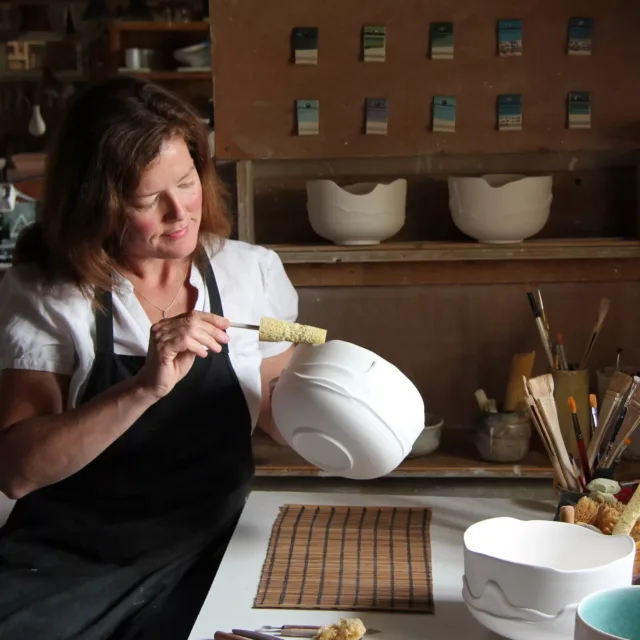
I attended the Pottery Skills and Design course from 2012 to 2014: an inspiring two-year immersion in pottery and design in the beautiful, bucolic landscape of Thomastown, Co. Kilkenny with the Design & Crafts Council Ireland. It was rigorous and demanding, yet deeply formative—long days at the wheel learning to truly see, to think through clay, to honour form and proportion. Guided by remarkable tutors, I gained skills and sensibilities I carry with me every day. If you feel called to clay and want to throw with confidence and soul, this is the course for you.
Bernadette Tuite
Careers
Graduates of this programme are prepared for a wide range of careers within the ceramics and wider craft and design industries. Many progress to become independent ceramic artists or designer–makers, producing original work for galleries, retail outlets, and exhibitions. Others work in studio production environments, education, or in roles linked to design, product development, and batch manufacturing. The programme also equips graduates with strong entrepreneurial and professional skills, supporting pathways into self‑employment, creative business development, or further postgraduate study in related creative fields.
Further Information
Application Closing Date
11th May 2026
Who Should Apply?
This programme is ideal for individuals who have a strong interest in ceramics, craft, and design, and who wish to develop high‑level practical making skills alongside creative and professional competencies. It is particularly suited to those who enjoy hands‑on learning, studio practice, problem‑solving, and working with materials. The award is also appropriate for learners seeking a career as a ceramic artist, designer–maker, or creative professional within the wider craft and design industries. Applicants should be motivated, willing to engage in intensive practical work, and eager to develop both technical expertise and their own artistic voice.
Contact Information
For queries relating to the course:
E: educationadmin@dcci.ie
For queries relating to the application: